
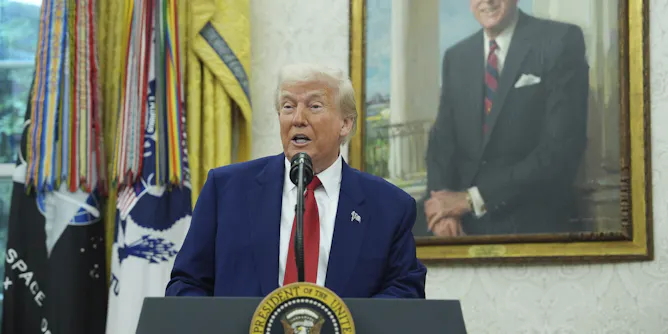
Trump has demanded loyalty from his appointees – but he’s finding he can’t control the judiciary.
Articles on Judicial system
Displaying 1 - 20 of 40 articles
There’s a separate justice system for people under 18 because their brains are still developing. Treating them as adults can turn them into repeat offenders.

Even when courts are provided with race-informed clinical assessments designed to contextualize trauma and systemic vulnerability, Black youth are still seen as a risk.
Juries now decide only a tiny share of civil and criminal trials in the US – and that hurts democracy.
Too many burnt out judges could mean shortages, a clogged court system and lower quality judgments.

Opponents fear electing judges could politicise the judiciary, promote inexperienced or corrupt judges, and erode Mexico’s system of checks and balances.

The federal government’s recent AI policy attempts to outline applications of AI for increased efficiency but fails to thoroughly consider the implications of the technology for delivering justice.
In 1974, the Supreme Court accepted, heard and decided a case within two months because the justices understood its importance to the public.
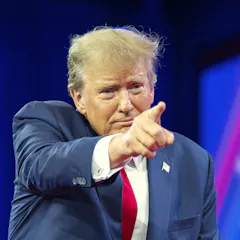
Trump’s efforts may appear to play by the rules, but in reality they ignore key aspects of the rule of law because he does not act in good faith.

Presidents have historically criticized judicial decisions. But Trump is taking it a step further with potentially dangerous personal attacks on judges.

Artificial intelligence could help create transparency and consistency in the legal system – our model shows how.

Victims of violence are often retraumatized by a legal process that puts prosecuting the accused ahead of supporting the victim.
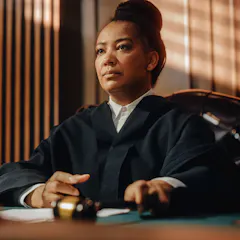
A new study reveals a reliable pathway to make U.S. courtrooms – and senior-level positions – more diverse.

Unlike in most countries, US Supreme Court justices enjoy life tenure. Some legal scholars believe that centuries-old custom, meant to protect judicial independence, no longer serves the public.

Unlike in most countries, US Supreme Court justices enjoy life tenure. Some legal scholars believe that centuries-old custom, meant to protect judicial independence, no longer serves the public.

Many states have found ways to remove partisan politics from their court systems.

From Europe to Latin America and the US, former world leaders are being investigated, tried and even jailed. In theory, this shows no one is above the law. But presidents and PMs aren’t just anyone.

Considering the limitations of Indonesian law enforcement agencies and prison capacity, the implementation of the bill is not realistic.

Amy Coney Barrett may be a woman, but Trump’s other judicial appointments are 85% white and 76% male – the least diverse group of federal judges since Ronald Reagan.

Given their ability to accept correction, children have a better claim to rehabilitation, reorientation and reintegration.
Top contributors
-

Professor of Legal Studies and Political Science, UMass Amherst
-
Professor of Political Science, Northern Illinois University
-
Associate Professor of Political Science, Oregon State University
-
Professor of Political Science, Purdue University
-
Professor of Law, UNSW Law School, UNSW
-
Ph.D. Candidate in Russian Literature, Columbia University
-
Emeritus Associate Professor in Public Law, UCT. Visiting Adjunct Professor, WITS School of Governance; Director, Africa Programme, University of Cambridge Institute for Sustainability Leadership, University of Cambridge
-
Professor of Law, Texas A&M University
-
Dean, University of Ghana School of Law, University of Ghana
-
Professor of Political Science and Affiliate Law Faculty, Penn State
-
Associate Senior Research Fellow, British Institute of International and Comparative Law
-
Professor of Political Science, Penn State
-
Research Fellow, School of Law, The University of Queensland
-
Visiting Lecturer, Georgia State University
-
Visiting Fellow, Feinstein International Center, Tufts University