
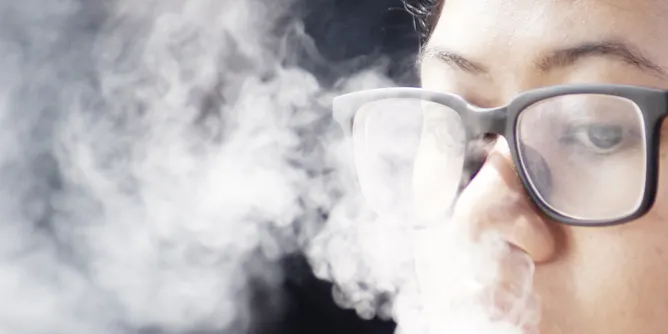
While many of its Asian neighbours are striving to get smoking under control, Indonesia is the stubborn exception.
Articles on Jakarta
Displaying 21 - 40 of 45 articles

Drivers for online ride-hailing services face several social conditions that may challenge their efforts to transform collective action into a solid union.
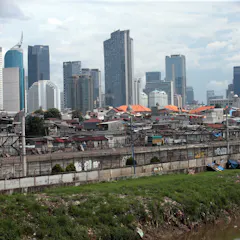
While it is true that the poorest residents of the city are not connected to the piped water network, neither are the richest. Then what causes water inequalities?
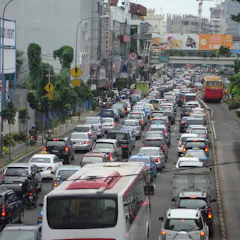
Governments are using Big Data to design improvements and upgrades of cities. But ethical questions need to be considered, lest we end up jeopardising citizens’ privacy or deepen social inequalities.
Perceptions in Indonesia towards LGBT as revealed in a national survey.
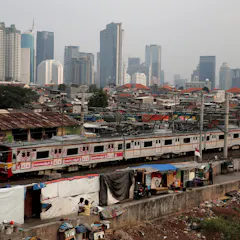
Amid rising inequality, two inclusionary planning instruments are at work to combat it in Indonesia. But without better enforcement, their full benefits will not be realised

Jakarta is finishing its water plan to have more public power in the private tap water service. However, the plan is unclear and likely to give small impact to the city’s unequal water distribution.

The growth of creative hubs is good for innovation but it may also widen a digital and economic divide in Indonesia.
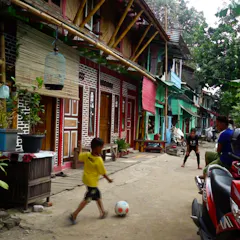
Some kampung in Jakarta have become hubs from participatory design and sustainable urban planning.
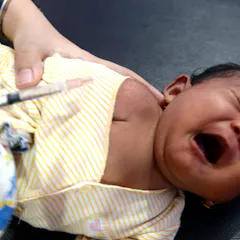
An outbreak of diphtheria in Indonesia is not caused by a singular factor. The country needs better vaccination coverage and distribution as well as better antibiotics.
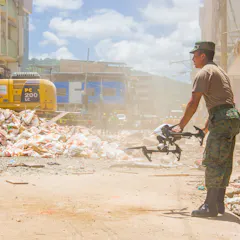
Stand by for drones, robots and sensors to the rescue.

Traffic continues to increase, but more slowly than would have been the case if the reforms had not gone ahead.
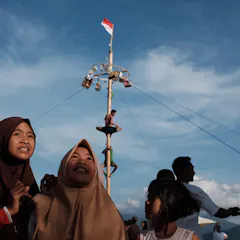
Welcome to our new colleagues in Indonesia.

Indonesian politicians have engaged in post-truth politics, framing information and stories by appealing to emotions with very little or no regard to any policy details and objective facts.
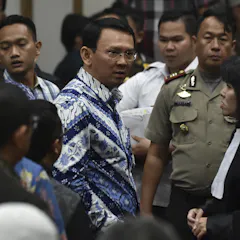
Ethnic Chinese and Christians in Indonesia have endured systematic and long-standing discrimination throughout the country’s history.
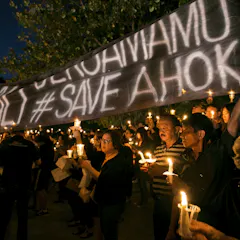
Ahok is only one among many people in Indonesia who have been jailed under the country’s controversial blasphemy law.
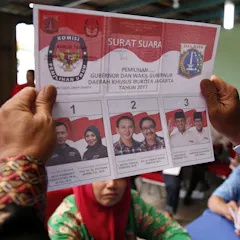
Would religious and ethnic narratives be effective at swaying voters?
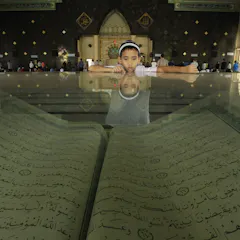
To avoid misguided use of sacred texts, religious believers should understand the context in which the texts appeared the first time.
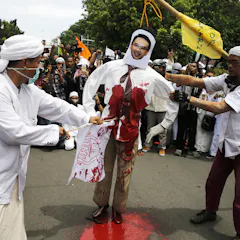
About one-quarter of the world’s countries, both in developing and developed economies, have anti-blasphemy laws. Their implementation is always controversial and highly politicised.
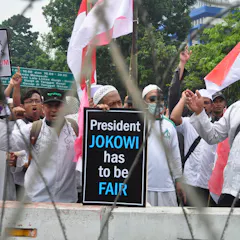
An enormous rally in Jakarta, organised by hardline Islamic militia group the Islamic Defenders Front, appears to have mobilised a diverse group of conservative Muslims in Indonesia.
Top contributors
-

Lecturer in Sociology, Universitas Indonesia
-
Lecturer, Department of Sociology, Universitas Indonesia
-
Assistant Professor, Universitas Indonesia - Associate, CILIS, Melbourne Law School, The University of Melbourne
-
PhD Candidate in Politics and International Relations, Monash University
-
Professor of Intelligent and Self-Organising Systems, Imperial College London
-
Professor, Crawford School of Public Policy, Australian National University
-
Assistant Professsor at the Department of International Relations, Universitas Gadjah Mada
-
Associate Dean (International and Advancement) and Professor of Mental Health and Implementation Science, University of Technology Sydney
-
Tutor in International Relations and History, The University of Melbourne
-
Associate Professor, Department of Anthropology, Universitas Indonesia
-
Researcher, Department of Politics and International Relations, Centre for Strategic and International Studies, Indonesia
-
Associate Professor of Geography, Université de Montréal
-
Chair in Natural Computation, Edinburgh Napier University
-
PhD Candidate, University of Amsterdam
-
Associate Professor, Urban & Regional Planning, Sydney School of Architecture, Design and Planning, University of Sydney