
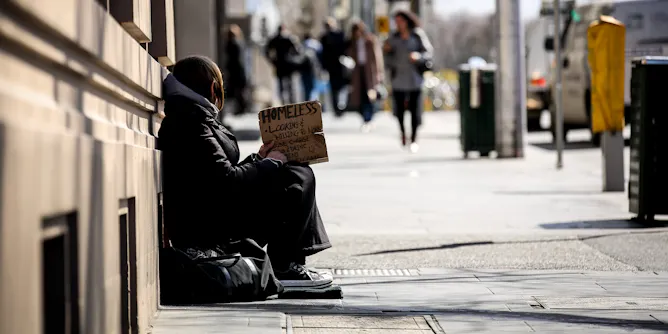
Young refugees are at high risk of being homeless in Australia. A five-year study has found re-establishing connections with their communities was the pathway out of homeless for most of them.
Articles on Homeless
Displaying 81 - 100 of 150 articles

Without a place to live it is nearly impossible to take care of your mental health needs.The upcoming Royal Commission should recognise the connection between stable housing and mental health.
Last week seven people were arrested for being alleged members of a begging ‘syndicate’. Stories like this entrench public perceptions of the homeless as criminal.
Many cities have no standard method for counting the number of people who live in their cars. This means that their issues are often overlooked in policies designed to help the homeless.

The largest group of homeless women is between the ages of 25 and 34, and family violence is most often the cause. Their stories testify to the dangers and stresses of not having a place to call home.
The brutal killing of a young homeless woman has led to calls for more crisis accommodation. This is a short-term fix. We have to move beyond crisis management to sustained housing for people at risk.
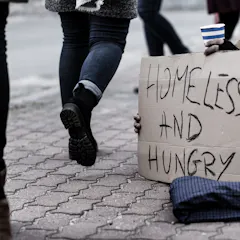
Homelessness in Australia is increasingly concentrated in the capital cities, where nearly two in every three people without a home are now found. That’s the finding of a study of the data since 2001.
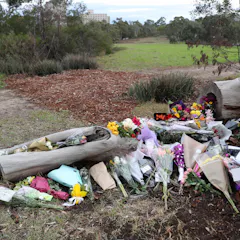
Media coverage often uses the label ‘homeless’ in ways that link the plight of tens of thousands of Australians to criminality. But a homeless person is much more likely to be vulnerable than violent.
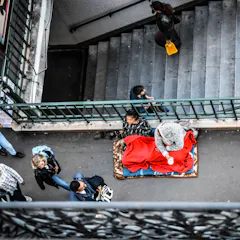
Whether it’s through begging or building shelters, homeless people are trying to make their lives better.

In 2008, Australia had a national homelessness strategy, plus a ten-point roadmap to reduce youth homelessness. Why has it fallen so far short of its goals, and what still needs to be done?
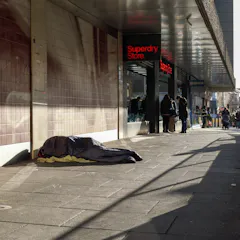
Homelessness in the UK has been rising for a decade – short term funding may have offered respite, but it won’t lead to long term solutions.

From the curious to the serious – a bird’s eye view of the unique ways in which The Conversation covers the world.
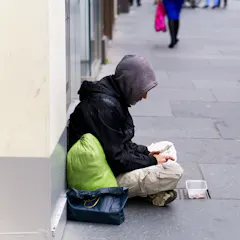
Shambolic rollout of new recording system for people at risk of homelessness means statistics shouldn’t be trusted.

Life on the street is no place to recover from a stay in hospital, but that’s what happens to many people who are homeless. But there’s a proven model to provide care that also cuts healthcare costs.

Surveillance often results in people who are homeless being the target of enforcement measures. But a new study in Cairns shows surveillance can also be used to achieve more positive social outcomes.
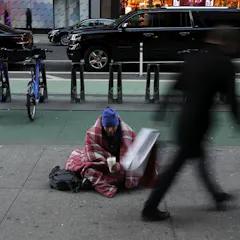
With such an enormous challenge, where would it make sense to start? We looked into our archives for stories on what it would take to eradicate homelessness in the US today.
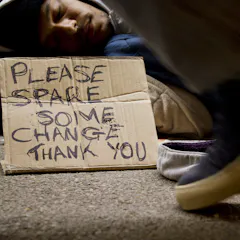
Problems such as mental illness and drug addiction are confined to a minority of homeless people – and it’s preventing others from getting help.
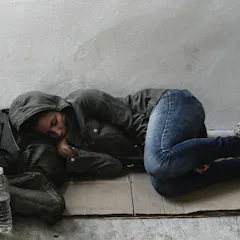
Survival sex can be a viable option for women managing homelessness. It ranged from staying with men for a night or a woman remaining in a sexual relationship to avoid becoming homeless again.

Design principles, known as ‘crime prevention through environmental design’, are used all over the world to make cities safer. But some of these principles can be discriminatory and hostile.

It’s said Australia’s housing affordability problem is the result of new housing stock not keeping pace with population growth. But there is actually enough housing, so why can’t the poor afford it?
Top contributors
-

Professor, School of Social Science, The University of Queensland
-
Associate Professor, Adelaide University
-
Reader in Social Policy, Nottingham Trent University
-
Honorary Fellow in Criminology, The University of Melbourne
-
Adjunct Senior Research Fellow, Gonski Institute for Education, UNSW
-
Emeritus Professor of Housing, UNSW
-
Senior Research Fellow, Social and Global Studies Centre, RMIT University
-
Vice Chancellor's Postdoctoral Fellow, RMIT University
-
Francine V. McNiff Professor of Criminology, The University of Melbourne
-
Adjunct Associate Professor, University of New England
-
Professor of Medicine, University of California, San Francisco
-
Emeritus Professor of Housing and Housing Studies, RMIT University
-
Professor of Social Policy, University of York
-
Senior Research Fellow, Housing, Homelessness & Urban Studies (HHAUS) research group, Swinburne University of Technology
-
Postdoctoral research fellow, Swinburne University of Technology