
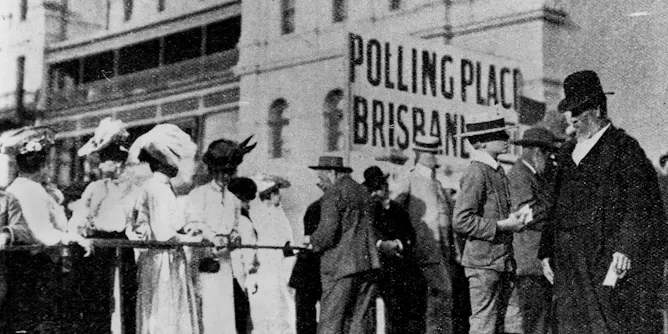
For decades, women from Munich to Melbourne, from Westminster to Washington, had been campaigning for a voice.
Articles on History and the Voice series
Displaying all articles
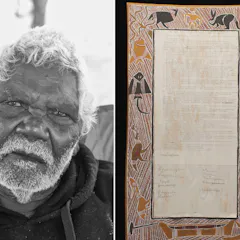
Clare Wright has spent ten years researching the history of these groundbreaking petitions. Though few Australians have heard of them, she writes, we can learn much from the story of their creation.
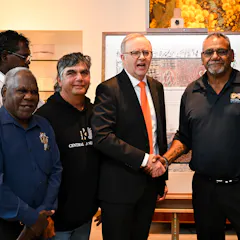
NT Land Councils have presented the Barunga declaration to Prime Minister Albanese, expressing support for the Voice to Parliament. The Barunga Statement in 1988 was an important part of this journey.
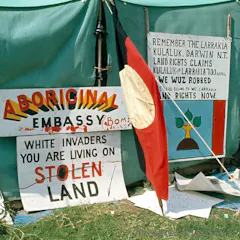
These histories remind us how long First Nations people have waited for political recognition in this country – and that, compared to other former colonial sites, Australia is the exception, not the rule.
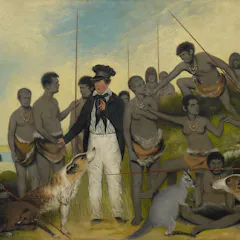
The office of the Protector of Aborigines was established in an effort to hear to the ‘wants, wishes and grievances’ of Aboriginal people. It failed almost immediately.
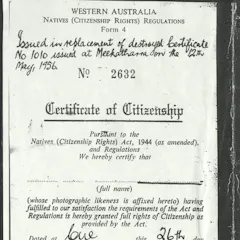
For nearly 30 years, Western Australia peddled the lie that Aboriginal people had to apply under state law to become ‘Australian citizens’.

What Yorta Yorta leader William Cooper was asking for was a means by which Australia’s lawmakers could be informed of the views of Aboriginal people.

The sad reality is that if the demands of these early activists had been met nearly a century ago, we would not be suffering the severe disadvantage that hovers over Aboriginal lives still today.
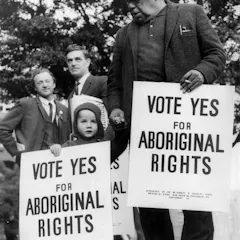
If the 2023 referendum fails, it will at least in part be due to the shortcomings and spoiled hopes of 1967.
In their 1881 petition, Aboriginal people from the Maloga mission who sought greater freedom from missionary control called for the government to grant them their own parcel of land.
Top contributors
-

Professor of History and Professor of Public Engagement, La Trobe University
-
Director/Chair of Aboriginal History - The Wollotuka Institute, University of Newcastle
-
Stephen Gapps is a Friend of The Conversation.
Historian and Adjunct Lecturer, Charles Sturt University
-
Professor, Australian and Aboriginal History, Faculty of Arts, Design and Architecture, Convenor: Indigenous Land & Justice Research Group, UNSW
-
Professor and Academic Director (Indigenous Research), La Trobe University
-
Affiliate of the University of Sydney Law School, University of Sydney
-
Lecturer, Faculty of Law, University of Technology Sydney
-
Professor of History, Monash University
-
PhD Candidate, Macquarie University
-
Emeritus Professor - History, La Trobe University
-
Professor of History, Australian Catholic University
-
Senior research fellow, University of Technology Sydney
-
Senior Lecturer in History, Australian Catholic University
-
Faculty of Arts Indigenous Postdoctoral Fellow, Indigenous and Settler Relations Collaboration, The University of Melbourne