

Teachers have gained some skills, but the GPS test is not an effective means of helping pupils become better writers.
Articles on Grammar
Displaying 1 - 20 of 75 articles

Yoda’s word order mirrors the syntax of British Sign Language.

Exaggerating phrases and talking in a sing-song way can actually help, not make it harder, for young children to master speaking a language.

There is no age limit to our ability to learn a new language.

The Apostrophe Protection Society is going along very strongly; perhaps we need a Semicolon Supporting Society?

While the Court’s politics have veered right over the past decade, the justices’ prose has shifted left, becoming more colloquial and accessible.

Spanish has two ways of saying “be”, which forces language learners to see the world in a whole new way.

Ever wondered where everyday things got their names? Or where words come from? Language is a powerful thing, creating new words all the time.

The language and speech technology has been developed to provide linguistic accuracy and is grounded in teaching principles.

The idea a language should grow simpler if people need to learn it as adults has an intuitive appeal. But an analysis of more than 1,200 languages shows this doesn’t quite stack up.

Grammar is the backbone of any language and kids need to understand it to communicate effectively.

Linguists have long considered grammar to be the glue of language, and key to how children learn it. But new prose-writing AIs suggest language experience may be more important than grammar.

The grammar of persuasion can be subtle – but pro-lockdown tweeters tended to be more direct and less conciliatory than those they opposed.

The schools inspectorate’s policies about language are harmful to the most marginalised members of society.

Our research found that focused grammar teaching didn’t improve children’s writing.

A better understanding of language and its neuroscientific basis would help us handle linguistic issues throughout our lives.

It isn’t a matter of choosing between teaching grammar or teaching students to use their imagination in their writing. In fact, it makes sense to show them how grammar can enhance their creativity.

A young reader asks: How are languages formed?

Our children should no longer be taught formulaic writing. Writing education should encompass skills that go beyond the capacities of artificial intelligence.
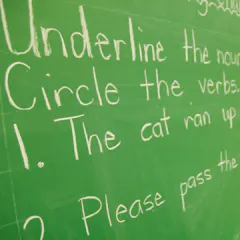
Grammar isn’t a way to bully people for making mistakes, says a longtime English instructor. It is a way to understand how our language operates, in all its many written and spoken varieties.
Top contributors
-

Honorary Associate Professor in Writing, The University of Queensland
-
Associate Professor in Linguistics, Macquarie University
-
Associate Professor in Language, Literacy and TESL, University of Canberra
-
Professor of Sociolinguistics, Manchester Metropolitan University
-
Associate Professor in Linguistics, University of Waikato
-
Senior Lecturer in Linguistics, Monash University
-
Adjunct Lecturer, School of Languages, Literatures, Cultures and Linguistics, Monash University
-
Professor of English Language and Literature, University of Oxford
-
Course Leader of Insessional English (EAP), University of Bath
-
Senior Lecturer, School of English, Media Studies and Art History, The University of Queensland
-
PhD Student, School of Education, Curtin University
-
Assistant Professor of English, School of Commerce, Waseda University
-
Professor of Linguistics, Queen Mary University of London
-
Senior Lecturer in Applied Linguistics, The Open University
-
Professor of Applied Linguistics, Department of Education, Concordia University