
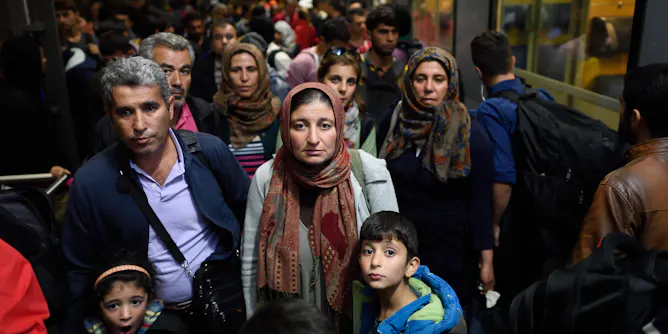
We identified a strong correlation between how humanitarian someone generally is, and the compassion that respondent expressed toward the refugees.
Articles on Germany and refugees
Displaying all articles
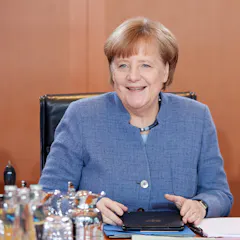
The German approach to refugees is becoming increasingly binary: if you are not a refugee, you must leave; if you are a refugee, you must integrate.

Over three months since Germans voted in national elections, preliminary talks are due to start Jan. 7 on forming a coalition government. What has taken so long?

Germany’s plan to build reception centres in Morocco to repatriate unaccompanied minors is similar to a controversial Spanish plan from the mid 2000s.

The Berlin terror attack at the end of 2016 will have major political implications for Germany’s elections this year and an uneasy European Union, writes a German studies scholar.

Germany’s problems with integrating immigrants date back to before the refugee crisis.
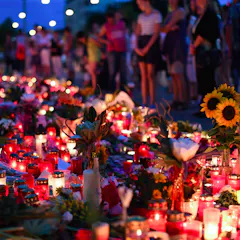
Instead of seeking to blame immigrants or Islamic State, Europeans need to rise to the challenge posed by the modern world.

Rule one: don’t lose ‘ownership’ of the issue.

Europe’s biggest achievements, such as open borders and human rights, are at risk as government responses to the refugee crisis fall short.
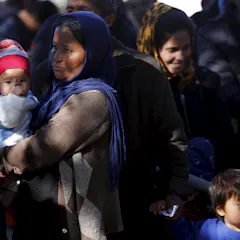
The experience and situation of many of the refugees precludes successful treatment of PTSD due to the nature of the disorder and what it requires to ease.

The attacks in Paris are putting refugees in the crosshairs, yet it’s the integration of these and past migrants that are key to the security of Europe.
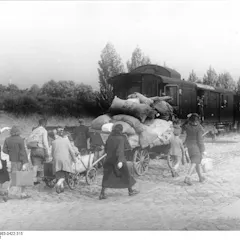
In the years following the end of World War II, Germany took in between 12 and 14 million refugees. What lessons does this past disaster have for today’s Europe?
Top contributors
-

Professor in Contemporary European History, University of Stirling
-
Research Fellow (Henry Jackson Society - Centre on Radicalisation & Terrorism), Royal Holloway, University of London
-
Postdoctoral fellow, Casa de Velázquez
-
Vice Director of the University Observatory on Security, Université de Genève
-
Director and Chair, Department of Medicine, Technische Universität Dresden
-
Lecturer and Research Fellow, UNSW
-
Theme Leader, Mind and Brain, South Australian Health & Medical Research Institute
-
Associate professor of Government at Wesleyan University, Wesleyan University
-
Professor, School of Social and Political Sciences, The University of Melbourne
-
Russell Colgate Distinguished University Professor of History, Colgate University
-
Assistant Professor of German and Global Studies, Michigan State University
-
Associate Professor and Fellow in Politics, University of Oxford
-
PhD Candidate in Management, Columbia University
-
Professor of Criminology and Criminal Justice, Northeastern University
-
Physician, University Hospital Carl Gustav Carus, Technische Universität Dresden