

Our analysis reveals the participation rate is alarmingly low for some groups of students, such as First Nations kids and students from educationally disadvantaged backgrounds.
Articles on Future of NAPLAN
Displaying all articles

To assess problem-solving, creative and critical thinking skills on NAPLAN would fit with broader movements in education internationally, but there are some questions to address first.

There is no need for all students to sit the same test, that asks the same questions, on the same day. We are smarter than that.

Literacy and numeracy can be assessed through creative tasks, like creating a drama performance or an electrical circuit, without hindering creativity.

NAPLAN has now been in place for a decade and needs ongoing review and refinement to make it more useful to classroom teaching and learning.
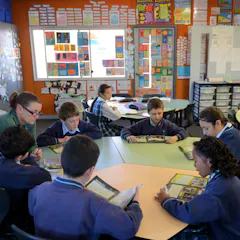
Getting rid of NAPLAN would allow teachers more time to respond to and address the needs of their students, rather than teaching to the test.

While we may need to rethink how we use NAPLAN, it is an important and useful tool for researchers and policy makers.

Assessments need to be relevant to the real world and test more complex skills to better predict competency, standards of literacy and teaching.
Top contributors
-

Professor, Southern Cross University
-
Professor (Curriculum Inquiry / Rural Education), University of Canberra
-
Professor, Faculty of Education and Arts, Australian Catholic University
-
Consultant, Australian Council for Educational Research
-
Professor, Griffith Institute for Educational Research and School of Education and Professional Studies, Griffith University, Griffith University
-
Lecturer in Arts Education, Western Sydney University
-
Deputy Dean, School of Education, Western Sydney University
-
School Education Program Director, Grattan Institute
-
Adjunct Senior Lecturer, Faculty of Education and Social Work, University of Sydney
-
Principal Researcher, Curtin University