
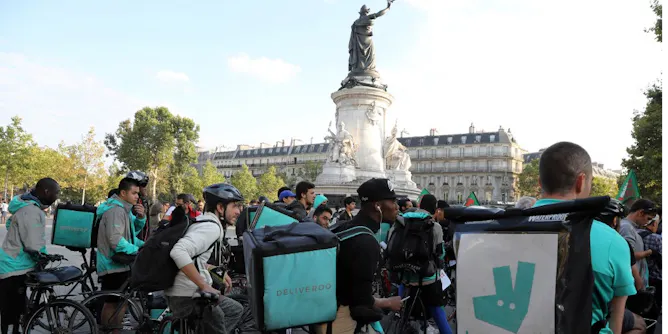
A trial in France revealed how the platform’s algorithm established a subordination relationship between riders and the firm. Could we be witnessing the beginning of the end of “uberisation”?
Articles on Foodora
Displaying all articles

Wanting a union and securing a union are two very different things. That’s because there are enduring obstacles to unionization that make it incredibly difficult for workers to unionize.

Food delivery apps charge significant fees for orders, meaning restaurants already challenged by the pandemic can be squeezed into negative margins to access customers. Will cutting fees help?

Proposition 22 keeps workers for app-based companies like Uber and Lyft classified as independent contractors, but it also reveals deeper problems with contemporary labour markets.

An Ontario labour board decision to allow Foodora workers to unionize appears to have set an important precedent. But unionizing workers in the gig economy will continue to be an uphill battle.
The tensions between platforms and their workers can be better understood by studying the mutual expectations of both parties.

It is the Australian Tax Office, not the Fair Work Commission, making the big waves with the Foodora case and the future of the gig economy.
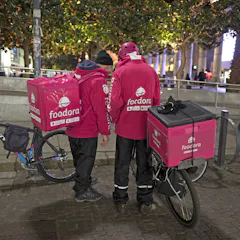
That the Fair Work Ombudsman brought a case against Foodora suggests its workers are most likely to be classified as employees. This could dissuade other platforms from offering similar benefits.

Could an employer or platform claim copyright in a chat group? We’d first have to accept that conversations in a chat group are protected by copyright.
Top contributors
-

Senior Lecturer, Management and Organisations, UWA Business School, The University of Western Australia
-
Senior Lecturer, Management and Organisations, The University of Western Australia
-
Professor, Labour Studies, Brock University
-
Associate professor, University of Sydney
-
Lecturer in Management, Employment and Organisation, Cardiff University
-
Assistant Professor, Labour Studies Program, University of Manitoba
-
Professor, Food Economics, University of Guelph
-
Maîtresse de conférences en sciences de gestion, Université Côte d’Azur
-
Dean of Programs, EM Lyon Business School
-
Professor of Law, University of Sydney
-
Associate Professor, Labour studies, Brock University
-
Associate Professor, School of Labour Studies, McMaster University