

A look at cats’ diets as reported by researchers over many years shows they eat a lot more than people might think.
Articles on Felines
Displaying 1 - 20 of 22 articles

Thinking about how and where your cat roams outdoors can help safeguard biodiversity, feline and wildlife welfare and public health.

A new study isolated DNA from the tumours of 500 cats across 13 different tumour types and mapped the sequence of 1,000 genes often found mutated in human cancers.
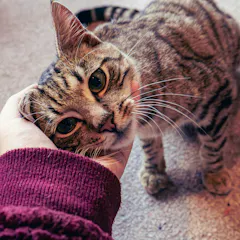
Cats are excellent at communicating, but humans still routinely misunderstand them.

Declawing cats causes irreversible nerve damage and chronic pain. New research from Quebec concludes it should be banned.
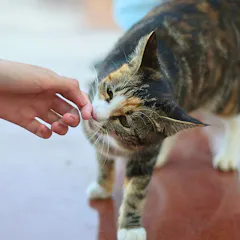
Dairy is not a natural part of cats’ diet – in fact, it can be harmful to their health.
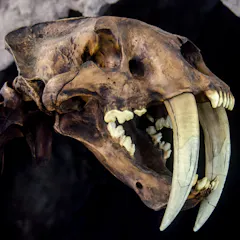
The long, sharp, blade-like canines found in many extinct predators evolved at least five times throughout history.

Surveys on cat personality are filled out by people. As such, results are affected by human perspectives, projections and biases.

Unfortunately, a rhetoric has developed within public discourse that cats are manipulative, vengeful, uncaring or even psychotic. But it’s unlikely they’ve deliberately peed on your rug to annoy you.
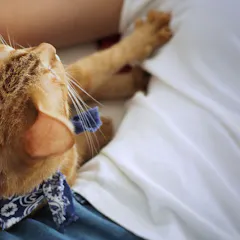
Kneading is typical kitten behaviour but may be retained into adulthood because it can help communicate messages.

Digging is a natural and important behaviour for cats – trying to interrupt it may cause stress and confusion for your pet. But if your cat is kicking litter everywhere, here are a few tips to try.
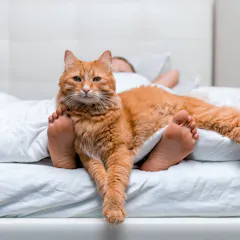
Although cats are evolved for night-time activity, during domestication they have adapted to human lifestyles. There’s plenty you can do to try and get your cat to stop waking you in the wee hours.

The first sabre-toothed cat-like predator was not much larger than a bobcat, but it had long teeth and a strong jaw to cut through thick skin.

We found poorer areas, and areas with more people, were likely to have a greater number of unowned cats.

L’opinion généralement acceptée est que Madagascar n'a pas de chats indigènes, pourtant ils sont très nombreux.
According to a veterinarian, the behavior some people call ‘kneading the dough’ or ‘making biscuits’ is a clue your cat feels comfortable around you.

Research suggests that people can learn to read cats’ facial expressions.

Catnip can induce changes in cat behavior. An expert argues that giving it to cats raises questions about human power and animal autonomy.

Cats evolved in hot desert regions where there were lots of small animals to eat. So they evolved feet that are perfect for pouncing on prey, climbing, scratching and jumping from great heights.

While cats – with their steely demeanor – have a reputation of being hard to read, humans seem intent on figuring out what they’re thinking and feeling.
Top contributors
-

Researcher, School of Animal and Veterinary Science, Adelaide University
-
Associate Professor, School of Animal and Veterinary Science, Adelaide University
-
Veterinary Specialist, Research Fellow, University of Technology Sydney
-
Professor of Wildlife Biology and Conservation, Auburn University
-
Professor of Entomology, University of Hawaii
-
Biological anthropologist, University of Colorado Boulder
-
Honorary Research Fellow, Bristol Veterinary School, University of Bristol
-
Senior Research Scientist, College of Veterinary Medicine, Purdue University
-
Postdoctoral fellow, Animal Biosciences, University of Guelph
-
Professor, University of Colorado Boulder
-
Richard Malik is a Friend of The Conversation.
Veterinary Internist (Specialist), University of Sydney
-
Associate Professor of Veterinary Medicine, University of Tennessee
-
Professor of Vertebrate Palaeontology, University of Bristol
-
Professor of Mathematical Biology and Public Engagement, University of Bath
-
Postdoctoral Research Fellow, Evans EvoMorph Laboratory, Monash University