

Tech platforms need to be responsible for reporting online child sexual exploitation rather than relying on victims to do so.
Articles on eSafety
Displaying 1 - 20 of 35 articles

The government is returning to some unfinished business: strengthening its social media age restrictions.

The Roblox saga is a reminder that parents can’t leave children’s online safety to platforms.

The eSafety Commissioner alleges Telegram failed to detect and remove pro-terrorist and extremist material, including videos of executions and attacks.
The new safety features could help reduce online harm – but they ask a lot of parents.

eSafety is investigating Facebook, Instagram, Snapchat, TikTok and YouTube for “potential non-compliance”. But several questions about the ban remain unanswered.
A new eSafety report reveals an ongoing gap between what technology can do and what companies are actually doing to tackle child abuse.

The new year will bring new controls over what you see online – such as blurring pornographic or violent search results if you’re not logged in.
It comes at a time when the online gaming giant faces several lawsuits and growing calls to be included in Australia’s social media ban.
The first ever state-based inquiry into the impacts of porn challenges simplistic ideas in favour of nuance, and calls for better sex ed.

Banning ‘nudify’ apps is an important step, but alone it won’t stop the harm they cause.

AI-generated deepfake abuse material is easy to create – but there’s plenty we can do to stop it spreading in our schools.
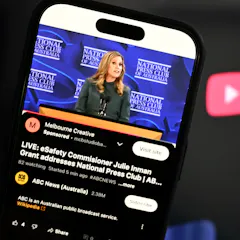
The Albanese government will include YouTube accounts in its ban on access to social media for those under the age of 16.
Before December search engines such as Google will need to implement several other measures aimed at protecting children online.

AI is just one of the emerging threats online that won’t be tackled by the social media ban.

Draft rules to restrict ‘age-inappropriate content’ may also affect essential information about sex and sexual health.

The standard aims to prevent the spread of child exploitation and pro-terror content. But there are problems with it.

Unfortunately, most of us are probably more hygienic in bathrooms than we are online.

Even if the new safety codes are approved, kids could still access online porn and deepfake apps because of flawed age assurance technology.

The Albanese government will develop and legislate a “Digital Duty of Care” to place the onus on platforms to keep people safe and better prevent online harms.
Top contributors
-

Professor of Information Sciences & Director, Social Change Enabling Impact Platform, RMIT University
-
Professorial Fellow, University of Canberra
-
Adjunct Associate Professor, School of Law; Academic Co-Lead, CSAM Deterrence Centre, University of Tasmania
-
Associate professor, Monash University
-
Professor of Cybersecurity, School of Computing and Information Systems, The University of Melbourne
-
Sexologist & Lecturer and Research Fellow in Communications & Culture, Edith Cowan University
-
Professor in Information Systems, The University of Queensland
-
PhD candidate researching children's play in digital games, The University of Melbourne
-
Professor in Human-Computer Interaction, ARC Future Fellow, University of Sydney
-
First Nations Academic Associate, Australian National University
-
Senior research fellow, UNSW
-
Associate Professor, Federation University Australia
-
Research Fellow, Australian National University
-
Senior Lecturer in Digital Technologies for Learning, University of Wollongong
-
Executive Officer, Kimberley Institute