

For Canadians hoping to emerge from the pandemic with better jobs, a stronger economy and reduced inequality, employee ownership combined with employee participation is a promising way to get there.
Articles on Employees
Displaying 81 - 100 of 213 articles

Providing support at work can be a cost-effective strategy.

Feudalism has been replaced by capitalism, and the new villeiny — or neo-villeiny — has emerged to reflect a relationship between a worker and an organization.

An increasing number of workers are demanding a more human-centric work environment, with space to express trust and vulnerability.

Many Americans regularly report that they don’t make enough to support their families. Status plays a role — while money can’t buy happiness, it can bring status, which can lead to happiness.

The passion paradigm can fuel demands for better, more meaningful work, but this is only possible when it’s accompanied by a strong social safety net.

Organizations can reduce some of the negative effects of the COVID-19 pandemic. Providing customizable support measures can improve employees’ work commitment and well-being.

The deaths of six Amazon employees at a factory hit by a tornado raises concerns over prohibitions on cellphones for workers.

Employees are demanding a more human-centric workplace, with space for trust and vulnerability. Management is over. The era of co-creation is underway.

One of the major paradoxes that skilled migrants face is that despite gaining entry into a host country based on their credentials, that doesn’t guarantee success in the local labour market.

The right to disconnect can be the catalyst an organization needs to review its workplace policies. But what’s really needed is a cultural shift that gives workers more control over how they work.
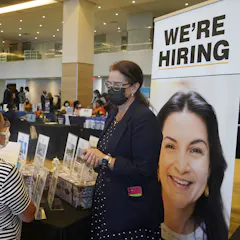
A record share of workers quit their jobs in September. A human resources scholar explains how this is a trend that predates the pandemic.

Two supply chain experts see a major flaw in how ratings agencies measure companies’ environmental, social and governance performance.

A new study found that having a trusting manager made employees feel more positively about their work.

While surveys have shown a large share of unvaccinated workers threatening to quit over a mandate, the reality is few actually do.

Suspensions don’t just harm Black children – they also harm their parents’ employment, a school discipline expert argues in a forthcoming book.

Do you actually need compulsory vaccination at your workplace? And if you do, as a last resort, how do you make mandates fair?

The post-pandemic return to work will provide an opportunity for employers and employees to reconsider relationships. Here’s how organizations can build morale and stop valued employees from leaving.

Post-pandemic, the world of work will probably never be the same again. And that’s probably a good thing. We now have an opportunity to make it better.

In post-pandemic Canada, the media will play a big role in shaping public understanding of labour conditions. A future of work that is safe and equitable requires the voices of workers.
Top contributors
-

Laurie Carmichael Distinguished Research Fellow at the Centre for Future Work, Melbourne; and Professor Emeritus, Griffith Business School, Griffith University
-
Professor and Director of Labor and Employment Studies, San Francisco State University
-
Associate Professor of Business and Society, Gustavson School of Business, University of Victoria
-
Professor of Business Law, Indiana University
-
Professor of Management, Co-Director of the MIT Sloan Institute for Work and Employment Research, MIT Sloan School of Management
-
DANCAP Private Equity Chair in Human Organization, Western University
-
Professor of Law, University of Oregon
-
Distinguished Professor and Borden Chair of Leadership, Smith School of Business, Queen's University, Ontario
-
Professor of Economics and Labor-Employment Relations, Penn State
-
Professor of Sociology and Canada Research Chair, University of Toronto
-
Associate Professor, University of Cape Town
-
Professor, Business and Management, Queensland University of Technology
-
Senior Research Associate, Oregon Health & Science University
-
Professor and Ken Croft Chair in Management, Haskayne School of Business, University of Calgary
-
Senior Lecturer, Graduate School of Business and Law, RMIT University