
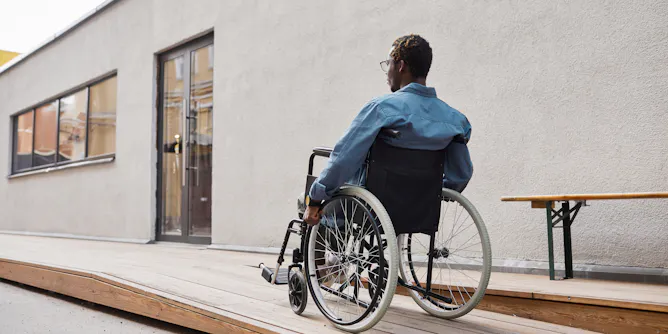
Both the royal commission and NDIS review recommendations say big changes are needed so people with disability can live where and with who they want – and be free from abuse, neglect and exploitation.
Articles on Disability coverage
Displaying 121 - 140 of 291 articles

Two new memoirs make blind writer Amanda Tink ‘very proud’ of her community – and share the stories of blind writers, performers, teachers, activists and inventors.

The NDIS review found a lack of clarity about what supports should be considered ‘reasonable and necessary’ was at the heart of many of the scheme’s problems.
Bill Shorten joins us on the podcast today to discuss the recent NDIS report and how he sees its path forward in modern Australia.

5 disability experts tell us their initial thoughts about plans to reform the NDIS and make it sustainable
Ahead of Thursday’s release of the review into NDIS, the states have agreed to provide more and expanded services for people with disability in exchange for an extension of the GST top-up.

Access to dental care in Australia is worse than ever and is simply unaffordable to many.

The first report linking thalidomide to birth malformations was made by Australian doctor William McBride. The drug led to thousands of instances of pregnancy loss, neonatal deaths and disability.

What fell away when the NDIS was rolled out? And what are the chances of such services being revived?

We’re getting better at early identification and adult diagnosis has contributed to NDIS numbers. But functional impairment is likely to be given greater emphasis in the NDIS reboot.

New data from Queensland shows there has been a 20% increase in homeschooling in the state over the past year.

After more than 700 submissions and evidence from 79 witnesses at three public hearings, the senate inquiry into ADHD diagnosis and treatment barriers has delivered its findings.

One treatment option for children’s trauma is eye movement desensitisation and reprocessing, or EMDR. Here’s how it works and what the research says about its effectiveness.

Currently, when someone turns 65 they are not eligible to apply for NDIS support, even if they had disability before then. We asked experts if that should change.

Over 20% of people diagnosed with brain cancer survive longer than five years. But the NDIS may not recognise their need for support to live, work, learn and play.

Stimulants are first-line drugs for attention-deficit hyperactivity disorder. But how do they actually work?
Currently, when a visa applicant or their child has a health condition or disability likely to incur ‘a significant cost to the Australian community’ they can be deported.

People with intellectual disability told us they often felt cut out of their own health appointments, as healthcare practitioners spoke to their support person or family instead of to them.

In new research, we spoke to parents who have children at special schools. They told us they value the individual support and smaller classrooms.

The disability royal commission was a once-in-a-lifetime chance to investigate the realities of life for disabled Australians. But it missed three critical areas in need or urgent reform.
Top contributors
-

Professor, Public Service Research, UNSW
-
Deputy Director, The Kids Research Institute Australia, Professor of Autism Research, The University of Western Australia
-
Adjunct Professor, Summer Disability Research Centre, La Trobe University
-
Professorial Fellow, University of Canberra
-
Disability Program Director, Grattan Institute
-
Professor, University of Sydney; RMIT University
-
Postdoctoral Research Fellow, UniSA Creative, Adelaide University
-
Professor and Clinical Psychologist, Michael Crouch Chair in Child and Youth Mental Health, University of Sydney
-
Psychologist and Research Associate in the Department of Paediatrics, Monash University
-
Professor, Director, Griffith Inclusive Futures, Griffith University, Griffith University
-
Senior Research Fellow, Crawford School of Public Policy, Australian National University
-
Head of Autism Research and Senior Principal Research Fellow, The Kids Research Institute Australia
-
Senior Lecturer of Wellbeing Science, The University of Melbourne
-
Research Fellow, Dignity Project, Griffith University
-
Financial Markets Foundation Chair of Developmental Mental Health, The University of Melbourne