
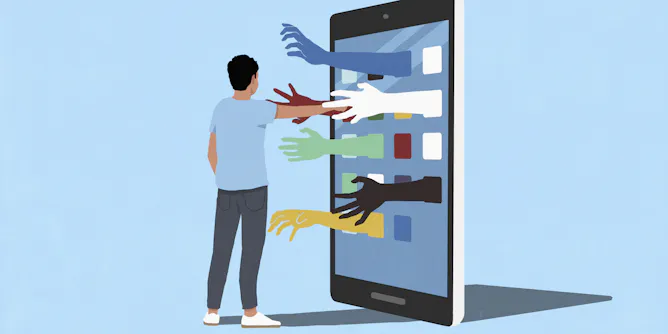
Recent research finds that becoming too psychologically entangled with your followers can make success feel like a trap.
Articles on Creative work
Displaying all articles
Opponents of guaranteed-income programs often argue that recipients will simply take the money and be less motivated to do any work whatsoever.

Whether they’re famous composers or first-year art students, creators experience reputational costs when AI enters the mix.
Instead of treating creative work as a legitimate field, US labor policy, copyright law and the tax code have failed to offer artists stability or protection.
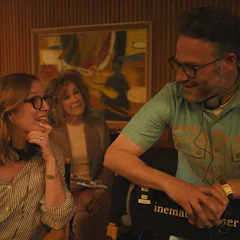
The ‘oner’ has a long history. Today, this unique approach to shooting has became a major test of creative vision.
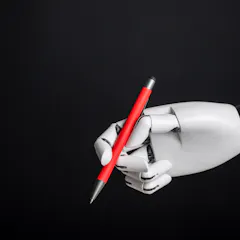
Participants in a study were willing to spend just as much time and money on an AI-generated story as one they were told was written by a human.
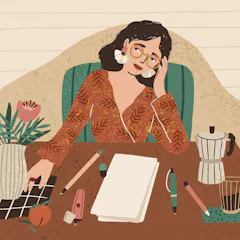
Creative work can be exciting and rewarding, but it also requires a lot of energy and stamina.

A wave of horror content is popping up across TikTok, carrying on a legacy that began on YouTube.
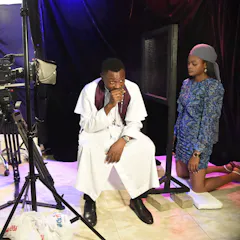
Nigeria’s president, Muhammadu Buhari, recently signed the copyright law. Its provisions will be beneficial only if it is well implemented.
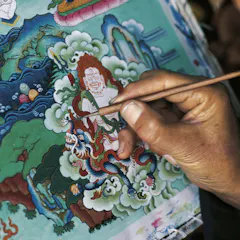
The technology’s focus on the framing of the artistic task amounts to the fetishization of the creative moment – and devalues the journey that waters the seed of an idea to its fruition.
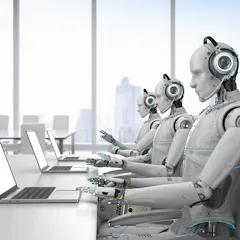
Now that AI systems can generate realistic images and convincing prose, are creative and knowledge workers endangered or poised for productivity gains? A panel of experts says it’s not so clear-cut.
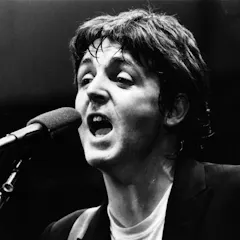
The ‘Eureka!’ moment is a myth – an altogether naïve and fanciful account of innovation.

E-changers are the latest group to move from the big cities to escape high living costs and congestion. But because they remain very productive remote workers some employers are embracing the trend.
A project to protect producers from food fraud by verifying and promoting the provenance of the region’s beef exports to China turned out to be a source of creative work in the region as well.
Longer doesn’t always mean better. But it’s not the end of the world, either.

A new project documents who uses urban industrial lands slated for redevelopment. It reveals a vibrant but largely hidden sector at the interface between creative industries and small manufacturing.
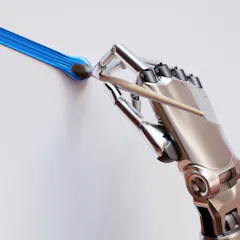
Artificial intelligence can now produce original paintings, novels and music.

The digital pin-ups’ business models actually inhibit serendipity and, indeed, innovation by absorbing entire markets into the sealed-off space of their platforms.

It’s questionable whether current copyright laws actually support artists or more local content.
Top contributors
-

Associate Professor of Public and Environmental Affairs, Indiana University
-
Research Assistant, Australian Centre for Culture, Environment, Society and Space (ACCESS), University of Wollongong
-
Australian Laureate Fellow, University of Sydney
-
Senior Lecturer in Intellectual Property Law, University of Sussex
-
Professor of Cultural Economy, Adelaide University
-
Professor of Autonomy in Art, Design and Technology, St Joost Art Academy, Avans University of Applied Sciences
-
Director, Melbourne Institute of Applied Economic and Social Research, The University of Melbourne
-
Professor, Faculty of Design and Society, University of Technology Sydney
-
Senior Lecturer in Communications and Media, Monash University
-
Professor of Media and Communication and Co-Director, Digital Ethnography Research Centre, RMIT University
-
Professor of Biomedical Informatics, University of Colorado Anschutz
-
Creative Partnership Designer and PhD Candidate, Queensland University of Technology
-
Associate Professor of Computer Science, Affiliate Professor of Information Science, University of Colorado Boulder
-
Associate Professor in Media, RMIT University
-
Professor and Director of Urban Planning & Design, Monash University