
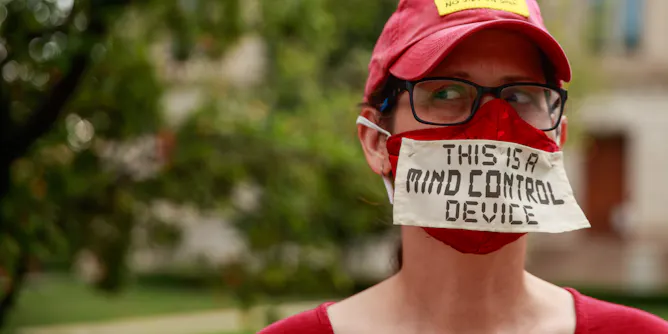
Our desire to condemn and punish non-cooperative behaviour is strong. But we must also try to understand the complex emotional motivations of those refusing to wear masks.
Articles on Cooperation
Displaying 21 - 40 of 46 articles

Taiwan and Iceland both deployed a cooperative strategy early on in the COVID-19 pandemic – and it’s helped win public trust.

Behavioural economics research suggests very few people will cooperate unless ‘free riders’ are punished.

Some initiatives aim to develop more ethical and equitable models.
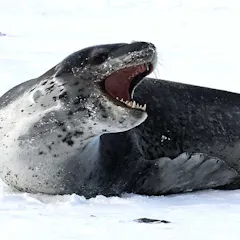
Cooperation or theft? New observations show wild leopard seals sharing food when targeting king penguins in Antarctica.

Do children understand the lesson that if you scratch my back, I’ll scratch yours? Developmental psychologists suggest they’re more likely to punish bad behavior than they are to reward good deeds.

From the biggest ‘wicked’ problems on down, finding solutions to challenges depends on working together collaboratively. Students think they’re good at this, but they aren’t. Here’s what could help.

The Mueller report reveals that some U.S. citizens helped Russian government agents organize real-life events, aiding Russia’s propaganda campaign. Don’t be like them.

Where do the cooperative skills that hold together human societies come from and why don’t our selfish instincts overwhelm them? Evolutionary game theory suggests that empathy is a crucial contributor.

Recycled or scrap parts including tunnels, pipes, crates, foam, rubber and plastic parts make for better play equipment for kids than a fixed swing set.

In April 2017 the IPSP conducted a survey on how cooperation and competition were perceived and how respondents felt in cooperative versus competitive situations.

How did civilization emerge from small groups of hunter-gatherers? Some archaeologists focus on cooperation as the vital ingredient – and find evidence for it in the form of feast-related artifacts.
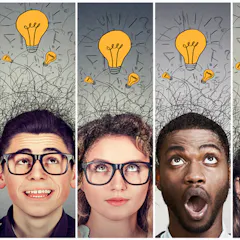
A new study shows how even having a few intelligent people in a group can benefit others.

Most anthropologists believe that witch labelling has evolved to get people to conform. But new research suggests an alternative explanation.

Remember that story about the molecule found in turkey that makes you drowsy? Research shows it’s a myth – tryptophan doesn’t cause you to nod off, but it may be connected to cooperation.

Today’s scientific research is characterized by interdisciplinary, international collaboration. Awards like the Nobel Prizes haven’t caught up.

South African business can beat back the toxic ‘white monopoly capital’ title by doing things differently and not by shouting from roof tops.

Piracy has risen and fallen with the ages, but international cooperation is the common factor behind their defeat.
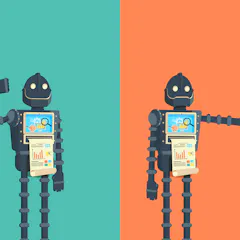
A European Union law will require human-understandable explanations for algorithms’ decisions. A team of researchers has found a way to provide that, even for complex calculations.

‘Treat 'em mean, keep 'em keen’ will not make you popular, according to new research.
Top contributors
-

Professor of Anthropology, UCL
-
Professor of Political Studies, University of Johannesburg
-
Lecturer in Law, Nottingham Trent University
-
Associate Professor of Computer Science and Electrical and Computer Engineering, Carnegie Mellon University
-
NERC Postdoctoral Researcher, University of Sheffield
-
Postdoctoral Fellow in the Department of Economics, University of Heidelberg
-
Post-doctoral Researcher, Magdalen College & Stipendiary lecturer, New College, University of Oxford
-
Professor of Economics, University of Bristol
-
Professor of Economics, University of Minnesota
-
Professor of Economics and Senior Researcher, Princeton University
-
Senior Research Associate in Life Sciences, UCL
-
-
Professor of Public Affairs, The Ohio State University
-
Postdoctoral Research Fellow, University of Technology Sydney
-
Full Teaching Professor of Psychology, Penn State