
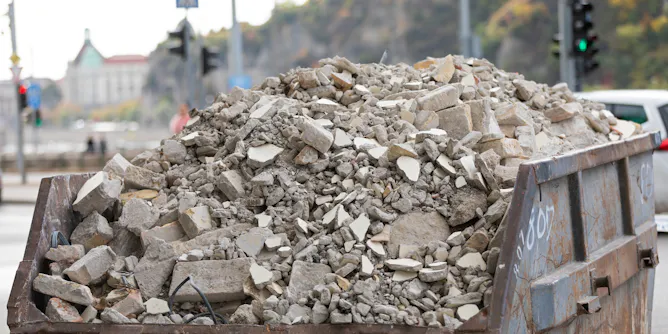
Construction waste can be turned into valuable new materials.
Articles on Construction materials
Displaying all articles

Construction activity will use up almost half of the world’s remaining carbon budget to keep global warming under 1.5°C unless we totally rethink our approach.
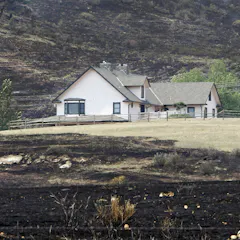
Roofs, windows and siding all affect how vulnerable a home is and how likely it is to survive a wildfire. So does what’s around it in the ‘home ignition zone.’

The recovery rate from construction and demolition waste has been rising steadily in Australia. However, the use of recycled materials is still not the norm across the construction industry.
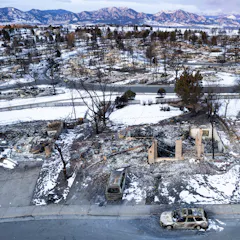
As more people move into high fire-risk areas, an architect explains what to do to keep properties as safe as possible.
As more companies feature wood and other bio-based products in their offices, what are opportunities and limitations of making corporate net-zero carbon pledges about building materials?
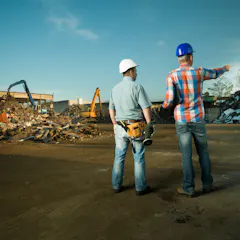
Construction and demolition creates more waste than any other sector, but much of it can be recycled. However, public resistance to setting up new plants stands in the way of a sustainable market.

Since the Grenfell Tower fire claimed 72 lives in 2017, Australia has identified flammable cladding on more than 3,400 buildings. Despite apartment owners’ fears and rising costs, few have been fixed.

A building designed to be easily taken apart so the components can be reused is a model for much less wasteful construction. It reduces resource use and environmental impacts, and can be cheaper too.

Plastics are strong, durable, waterproof, lightweight, easy to mould, and recyclable – all key properties for construction materials.

Bricks turn out to be useful for storing electricity thanks to their porousness and red pigment.

Researchers are turning microbes into microscopic construction crews by altering their DNA to make them produce building materials. The work could lead to more sustainable buildings.
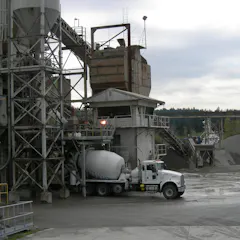
The cement needed to make concrete – the most widely used man-made material – is a major source of global emissions. Researchers are working on a green replacement that could transform the sector.
Top contributors
-

Senior Lecturer, School of Property, Construction and Project Management, RMIT University
-
Associate Dean and Head of Project Management, RMIT University
-
Graduate Student Researcher, Fire Center, University of Montana
-
Researcher on Plastics Recycling and Sustainability, University of Minho
-
Associate Dean, School of Property, Construction and Project Management, RMIT University
-
Director, Glowpear, Board member, ISDRS, Vice President, AHA and Senior Lecturer in Industrial Design, RMIT University
-
Professor of Industrial Engineering & Assistant Vice-President, International, Toronto Metropolitan University
-
Post-Doctoral Research Fellow, Department of Mechanical and Industrial Engineering, Toronto Metropolitan University
-
PhD researcher, Curtin University
-
PhD Candidate, School of Engineering and Information Technology, UNSW
-
Associate professor, The University of Western Australia
-
Associate Professor in Property, Construction and Project Management, RMIT University
-
Technical and R&D Manager, UBIQ Technology Pty Ltd, Western Sydney University
-
Associate Professor of Engineering, Western Sydney University
-
Post-doctoral Researcher, Fire Center, University of Montana