

Once classified files from East Germany reveal the extent of Soviet actions to hide the true extent of catastrophe.
Articles on Chernobyl nuclear disaster
Displaying all articles
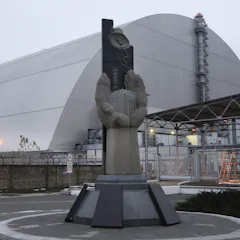
The nuclear incident at Chernobyl spread radiation across Europe and led to political changes that played a role in the collapse of the Soviet Union.
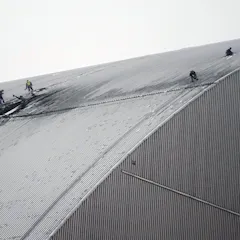
Radiation risk can be measured, understood and controlled in ways that keep people safe, including from contaminated foods.

Endangered species are making their home in a massive wild zone around the derelict Chernobyl nuclear plant.
Fission and fusion are both nuclear reactions. But while one involves splitting atoms, the other involves fusing atoms together.
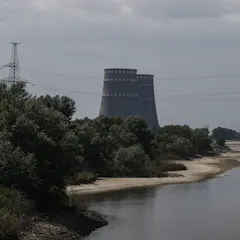
Several recent drones attacks on the site, which Russia captured in March 2022, highlight the potential for a major accident.
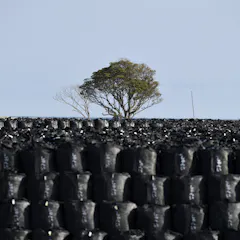
Japan has undertaken extensive efforts to decontaminate land in Fukushima – whether they were they right to do so is a complex question.
The UK is focusing on carbon capture and storage technologies but the future is uncertain.

Research on Chernobyl frogs has shown that the ionising radiation caused by the accident triggered a process of natural selection among these animals.

It is impossible to label nuclear power as sustainable without taking into account the entire life cycle of a nuclear reactor and the industry’s exposure to environmental and geopolitical risks.
Top contributors
-

Investigador postdoctoral Juan de la Cierva Incorporación, Estación Biológica de Doñana (EBD-CSIC)
-
Former Visiting Fellow, SPRU, University of Sussex Business School, University of Sussex
-
Research and Knowledge Transfer Manager, Department of War Studies and the Centre for Science and Security Studies, King's College London
-
Senior Lecturer in Energy and Climate Policy, University of Sussex
-
Profesor Titular de Zoología / Associate Professor of Zoology, Universidad de Oviedo
-
Professor of Environmental Science, University of Portsmouth
-
Lecturer, University of Auckland, Waipapa Taumata Rau
-
Professor, Mathematical Sciences Institute and School of Computing, Australian National University
-
Professor of Architecture and Urbanism, Manchester Metropolitan University
-
Professor of Nuclear Engineering, Director of the Center for Nuclear Studies, Kennesaw State University
-
Lecturer German and Russian Studies, Rose-Hulman Institute of Technology; Binghamton University, State University of New York
-
Professor, Russian and East European History, University of Alberta