
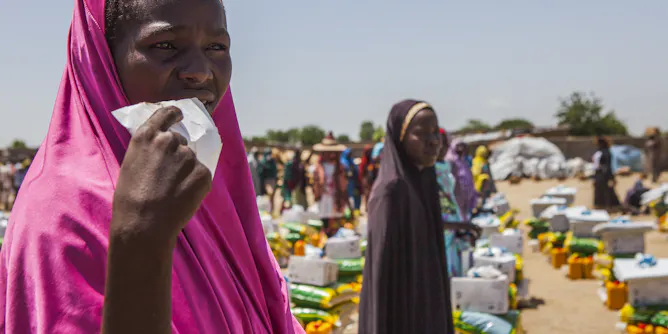
Sexual violence against women and girls in Nigeria’s northeastern region persists because of the Nigerian government’s lax response to cases of sexual offences.
Articles on Boko Haram
Displaying 61 - 80 of 193 articles

Jailbreaks in Nigeria point to the need to reform the justice system.

Improved mediation skills for local leaders can help prevent the escalation of disputes and break cycles of violence.

Pour résoudre les conflits djihadistes au Sahel, il faut aussi traiter les djihadistes comme des acteurs politiques qui cherchent à proposer une gouvernance alternative.

For a successful reintegration of former Boko Haram combatants into society, public perceptions in Nigeria need to change.

A new handbook shows that African entrepreneurs are able to hold their own globally if given the chance.

Mobile phones are enhancing the lives of internally displaced people in Nigeria.
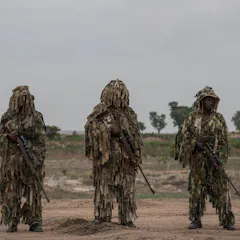
The atrocities and motivation of bandits have assumed insurgent-type criminality. But the Nigerian government is reluctant to label them terrorists or insurgents.
Exploring many contemporary cases of radical behaviour showed they had one thing in common: how the risk of radicalisation may be linked to fractured relationships.

Nigeria’s plan of de-radicalising and integrating former Boko Haram terrorists should be fine-tuned to achieve more.
Jihadi groups take advantage of endemic poverty, inequality, high unemployment levels, illiteracy, ethnic divisions, and poor governance to spread their campaign of violence in the Sahel region.
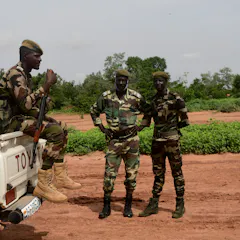
Resolving jihadist conflicts in the Sahel requires treating jihadists not as terrorists only but also as political actors who seek to provide an alternative form of governance to the status quo.

Islamic State West Africa Province appears to be consolidating its dominance in the region. This means Nigeria and other countries in the Sahel region have a lot more to be worried about.

Bans haven’t been effective in curbing the ubiquity of commercial motorcycles in Lagos.
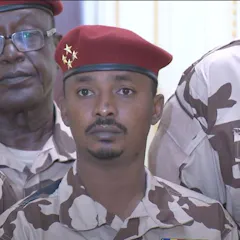
The struggle among elites has not resulted in efforts to improve the material lives of ordinary people unconnected to the political elite.

This is a transcript of episode 12 of The Conversation Weekly podcast, including a story on the reasons why Kenyan women who join Al-Shabaab.

Chadian president Idriss Deby’s death has serious implications for stability in the troubled Lake Chad Basin and the broader Sahel region of West Africa.

Plus, why women join Al-Shabaab in Kenya. Listen to episode 12 of The Conversation Weekly podcast.

Due to the poor security response of the Nigerian state, insurgency will continue to pose a serious threat to its northeast border communities.

In the past five years, the rise of banditry and terror attacks have had devastating effects on children in northern Nigeria.
Top contributors
-

Reader (Associate Professor) Department of Political Science, Federal University of Lafia, Nigeria, Federal University Lafia
-
Associate professor in Politics and International Relations, Leeds Beckett University
-
Lecturer in Political Economy of Violence, Conflict and Development, SOAS, University of London
-
Researcher, Centre for Peace and Security Studies, Modibbo Adama University of Technology
-
Lecturer, University of Northampton
-
Associate Professor in the Department of Political Science and International Relations, Nile University of Nigeria
-
Professor of World Politics, SOAS, University of London
-
Research Fellow, Obafemi Awolowo University, Regional Coordinator, Institute for Security Studies
-
University of Pretoria
-
Lecturer in Journalism, City St George's, University of London
-
Panitza Memorial Endowed Executive Director, Center for Information, Democracy and Citizenship at the American University in Bulgaria
-
Professor of Political Science, Department of Political Studies and Governance, University of the Free State
-
Lecturer, Department of Social Sciences, Technical University of Mombasa
-
Professor of International Relations and Visiting Scholar, Texas State University
-
Associate Profesor in Education and Global Development, University of East Anglia