
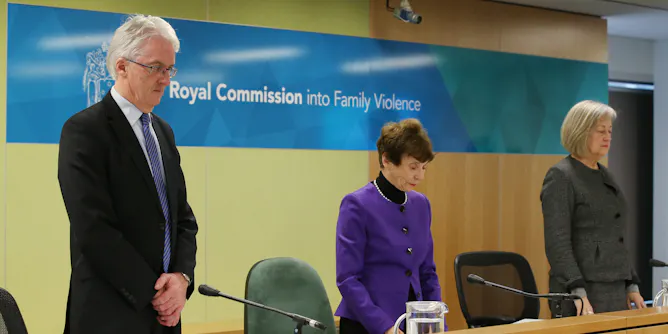
The royal commission’s recommendations seek a complete transformation of Victorian family violence services, and the state’s prevention of and response to family violence.
Articles on Australian law
Displaying 101 - 120 of 204 articles

What does the latest donations scandal enveloping the NSW Liberal Party say about the trajectory of political finance regulation and enforcement?

By requiring that a person acting in self-defence must act genuinely and reasonably, Australian states and territories appropriately balance self-defence against vigilantism.
After many weeks of speculation, the government has laid down the challenge for the Senate and smoothed the path for a double-dissolution election.

If passed, a new migration bill could mean that a person at risk of torture from the Syrian government would have to prove that they could not have gone to a part of Syria controlled by Islamic State.

While some progress has been made in reducing instances of forced marriage in Australia, more needs to be done.

The Australian Law Reform Commission has given George Brandis a report that does all that it reasonably could, while falling well short of what it was asked to do.
Australian parliaments routinely legislate in respect of socially contentious issues without resorting to plebiscites or referenda.
A suggested constitutional challenge to the Senate reforms through the High Court is unlikely to succeed.

In an era of ever-increasing counter-terrorism powers, what is Andrew Nikolic’s appointment to a powerful parliamentary committee likely to mean for its scrutiny of national security legislation?

The church’s assertion of sanctuary will stimulate debate about the morality and justice of Australia’s current laws with regard to asylum seekers.

As a country that claims to uphold the human rights of all – including those before the law – Australia should take notice of international practice when it comes to life imprisonment.

Queensland, New South Wales, Victoria and South Australia have introduced restrictive “consorting” laws. But are the laws justified? Are they an efficient and effective way to combat organised crime?

Until a public interest exemption is included in Section 35P, the offence will continue to impact press freedom and have a chilling effect on media organisations’ ability to report on ASIO’s activities.

It is easy to envisage a number of arguments that MPs might use in an attempt to justify ignoring the result of a same-sex marriage plebiscite and voting contrary to its result.

The legal status of private security staff is, for the most part, decidedly uncertain.

As the Law Council of Australia calls for the end of mandatory sentencing, it might be time for the Australian government to evaluate and resolve the troubles of this problematic system.

Detaining persons convicted of terrorist offences for lengthy periods after they have served their time could risk radicalising a section of the community who see the measure as unjust.

Gerard Baden-Clay’s successful appeal against a conviction for the murder of his wife should not be misread as a sign of judicial tolerance of domestic violence.

If we are content to sanction, disapprove and respond to sole nationals committing terror-related offences without revoking their citizenship, why is revocation necessary for dual nationals?
Top contributors
-

Associate Professor, Griffith Criminology Institute, Griffith University
-
Professor in Human Rights and International Law, University of Newcastle
-
Emeritus Professor in Law and Criminal Justice, Adelaide University
-
Professor of Law, UNSW Law School, UNSW
-
Research Fellow, School of Law, The University of Queensland
-
Professor (Practice), Faculty of Business and Economics, Monash University
-
Associate Professor in Criminal Justice and Criminology, Bond University
-
Associate Professor in Law, Adelaide University
-
Associate Professor, Law School, The University of Western Australia
-
Professor Emerita in Constitutional Law, University of Sydney
-
Associate professor, Adelaide University
-
Associate Professor in Law and Public Policy, University of Oxford
-
Assistant Professor in Public Law and Human Rights, Durham University
-
Senior Research Associate, Andrew & Renata Kaldor Centre for International Refugee Law, UNSW Law School, UNSW
-
Course Co-ordinator, International Law Clinical Program, ANU College of Law, Australian National University