

Kaleidoscopic color combinations can catch people’s attention before they even realize it, according to an eye-tracking study of real-world Facebook posts.
Articles on Attention
Displaying 21 - 40 of 74 articles
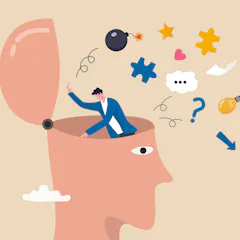
Navigating life with ADHD or as a parent of a child with ADHD can be stressful. But as researchers learn more about the uniqueness of brains with ADHD, they are also gleaning insight into treatments.

Raising children with behavioural, developmental or learning difficulties can also make parenting more challenging. So how can parent training help?

While a cup of joe or a brief nap during an all-nighter might help you feel a little more alert, it won’t offset cognitive impairments from sleep deprivation when you’re performing complex tasks.

In the marketplace of ideas, for an app or product to be considered successful, it must be widely adopted for it to represent an innovation.

There is a link between huge amounts of parental attention and the development of narcissistic traits in children.

Dobble is a card game that originated in France in 2009. It involves observation, articulation and speed.

With most social media users logging in at least once a day, and one-third of teens using these apps almost constantly, it raises the issue of whether social media is hurting our attention abilities.

With the proliferation of social media platforms, smart devices and apps, the demands on our attention have never been greater. But how is this affecting our ability to process and retain information?

Mindfulness is everywhere in pop culture today, but that doesn’t mean people agree on what it means.

Your phone doesn’t even need to ping for you to be distracted. Here’s how to reclaim your focus.

Research highlights the importance of daily meditation, exercise and sleep for improving executive functioning, a component of attention that helps people focus.

Cannabis use is linked to poorer memory, attention and mental health.

While only about 20% of people would qualify for a formal diagnosis of a mental disorder, more than 60% express symptoms of those disorders – and those symptoms can lead to cognitive difficulties.

Across Canada and the United States, more than two million people are living with aphasia and its language and communication challenges.

What use are we in helping to solve difficult global challenges if we’re so depressed and cognitively depleted that we can’t think of the best actions to take?

‘Attention snacking’ may help keep us alert.

Research shows that people with more flow in their lives had a higher sense of well-being during the COVID-19 pandemic. Scientists are beginning to explore what happens in the brain during flow.

If fidgety movements like drumming fingers or a swaying foot annoy you, there’s a word for that: Misokinesia.

A researcher who studies physical skills explains how getting your conscious thoughts out of the way lets your body do what it knows how to do, better.
Top contributors
-

Professor of Clinical Neuropsychology, University of Cambridge
-
Professor of Computational Media, University of California, Santa Cruz
-
Postdoctoral Research Associate, Cognitive Neuroscience, University of Cambridge
-
Lecturer in Psychology, Arden University
-
Associate Professor, Department of Philosophy, University of Birmingham
-
PhD in Cognitive Science, Dalhousie University
-
Assistant professor, University of Chicago
-
Senior lecturer, Sheffield Hallam University
-
Professor of Business Administration, Harvard University
-
Associate Professor, University of California, Berkeley
-
Loughborough University
-
Professor in Cognition and Neuroscience, University of East London
-
Ph.D. Candidate in English, The University of Texas at Austin
-
Director, First Year Learning Initiative at University College and Professor of Psychological Sciences, Northern Arizona University
-
Professor in Psychology, University of Florida