
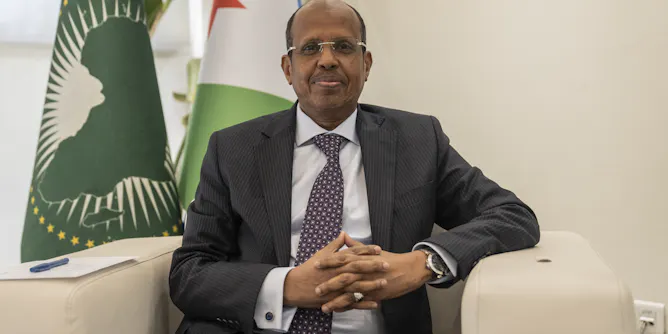
The new AU Commission chair promised to defend Africa’s fair representation and role in global forums. This is likely to be an uphill task.
Articles on African Union Commission
Displaying all articles

To make an impact, the AU’s incoming leadership must address six issues.
Some African nations are strengthening their democracy, while most are stuck in a dangerously authoritarian spiral.
African leaders have a worrying track record of prioritising narrow domestic gains over transferring supranational, binding powers to the AU.

The African Union’s membership in the G20 is an important complement to existing strategic partnerships.

The African Union needs to launch a credible, robust mediation process with mutually accepted mediators.

Just as Algeria and South Africa could not stop Morocco’s entry into the AU, neither can they stop Israeli accreditation.

Having four female Commissioners out of six is a good start, but that alone is will not erase the vulnerabilities that women face in leadership and everyday life.
The election of commissioners is a key step in the reform process of the African Union Commission.

The African Union’s role in Sudan’s political crisis proves that it’s legal framework is strong enough to resolve regional disputes

Africa’s new continental free trade area, the AfCFTA, is a remarkable achievement. However, decisive diplomatic, technical and social action is needed for it to succeed.
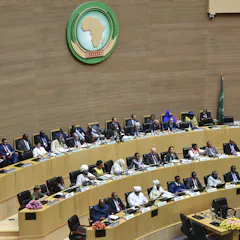
Despite taking a step backwards, the African Commission on Human and Peoples’ Rights can redeem itself by continuing to protect the rights of LGBTQ persons on the continent
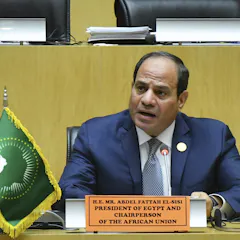
Having Egypt at the helm of the African Union might not bode well for human rights on the continent.

African leaders need to up their health allocations to help the new World Health Organisation Director-General meet his health care targets for the continent.

When the US Secretary of State stood up the AU Chairperson the writing was on the wall. Africa needs to become the master of its own destiny.

Getting local farmers involved in school feeding schemes has the potential to boost livelihoods and revitalise rural economies in Africa.

Firms with a focus on the domestic and regional market have an incentive to distribute their medicines effectively. Local production can create a win-win situation for health and employment.
Top contributors
-

Professor, Institute of African Studies, University of Leipzig
-
Programme manager of the Master's in Human Rights and Democratisation in Africa at the Centre for Human Rights, University of Pretoria
-
Professor of International Human Rights Law, Centre for Human Rights, and acting SARChI Chair in International Constitutional Law, University of Pretoria
-
Assistant Professor of International Relations, University of Amsterdam
-
Executive Director, Policy Research for Development
-
Lecturer in Intelligence Studies, Security Studies Discipline, School of International Studies, Macquarie University
-
Fellow, Nigerian Academy of Science
-
Senior Fellow, World Peace Foundation, Fletcher School of Law and Diplomacy at Tufts, Tufts University
-
Professor of Economics, The Open University
-
Research fellow, Institute on Comparative Regional Integration Studies (UNU-CRIS), United Nations University
-
Professor of International Law, University of Pretoria
-
Senior Professor and Academic Head of Department: Political Studies and Governance, University of the Free State
-
Senior Research Fellow, Legon Centre for International Affairs and Diplomacy, University of Ghana
-
Reader in Law, University of Sussex
-
Extraordinary Lecturer, University of Pretoria