

More Americans now hold absolutist positions, supporting legal access to abortion in all or most cases and opposing government regulation altogether.
Articles on Abortion access
Displaying 1 - 20 of 36 articles

This year, decisions from the courts, FDA or DOJ could all shut down telehealth for medication abortion, which is how most people in states with bans get care.

A Kentucky woman was arrested for ordering abortion meds online. Her case shows how bad policy can trap people just trying to cope with an unintended pregnancy.

Judges and federal regulators will make significant decisions over Americans’ reproductive rights.

A provision in the big legislative package and a related Supreme Court ruling mark the culmination of a strategy to defund the health care provider that was in full swing by 2007.

Increasing limits on abortion are boosting demand for contraception. But access to family planning is shrinking in many states, and access to highly effective forms of contraception is at risk.

Women’s stories of seeking abortions later in pregnancy highlight what’s missing from the current conversation about abortion policies in the US.

Research shows that when abortion rights are on the ballot, democracy wins − including in the US.
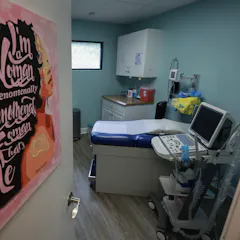
Iowa and Idaho have passed abortion trafficking laws that stop people from helping minors get abortions. These laws open the door for questions about the right to travel to get an abortion.
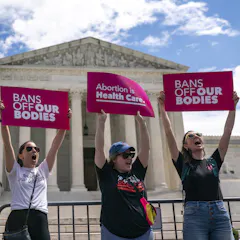
By offering abortion care benefits and policies, employers can serve as a “firewall” to protect against harmful legislation — but only if these benefits are easily accessible and de-stigmatized.

Abortion bans and restrictions have numerous downstream effects on health care. For instance, medical students in states where those laws exist will not receive training for some standard procedures.
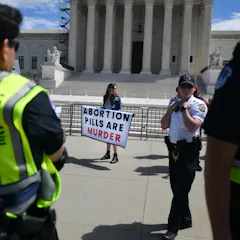
The 1873 Comstock Act makes it a crime to mail abortion drugs or medicine – raising legal questions about the law’s potential revival and influence over nationwide abortion laws.

When ideological enemies talk across their great divides, something good can happen – it reduces stereotypes and inflammatory language directed at people who don’t agree on the abortion rights issue.
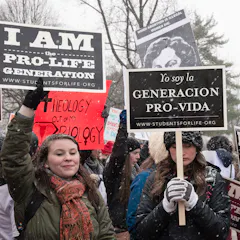
Some reasons people oppose abortion seem to be at odds with other positions they hold. Evolutionary social science points to a surprising motivation for anti-abortion attitudes.

Abortion funds, which help people who cannot afford the procedure, are facing new kinds of pressures, including potential legal risks and a rising client demand that exceeds their capabilities.

The concept of body ownership shows how the Supreme Court’s decision affects every woman, whether they can get pregnant or not.

There will no doubt be escalating rhetoric from anti-choice politicians in the wake of the fall of Roe v Wade. An abortion care provider says now is the time to improve abortion access in Canada.

An expert explains how reproductive rights are changing globally.
State supreme courts have a relatively low profile in the US. That’s going to change now that they will be under political pressure to decide whether abortion is protected in state constitutions.

Roe v. Wade demonstrates that reproductive rights are fragile, often insufficient and in need of protection everywhere.
Top contributors
-

Professor of Social Welfare, Stony Brook University (The State University of New York)
-
Professor of Law, The University of Texas at Austin
-
Professor of Law, University of Virginia
-
Professor of Law, George Washington University
-
Assistant Professor of Psychology, San José State University
-
Professor of Psychology, University of California, Los Angeles
-
Associate Professor of Pediatrics, University of Cincinnati
-
Researcher, University of California, San Francisco
-
PhD, School of Nursing, Dalhousie University
-
Professor of Philosophy, University of Southampton
-
Lecturer, Massachusetts Institute of Technology (MIT)
-
Associate Professor of Nursing, UMass Lowell
-
Associate Professor of Psychology, University of California, Los Angeles
-
Research Sociologist, University of California, San Francisco
-
Postdoctoral Fellow, Obstetrics and Gynaecology, University of British Columbia