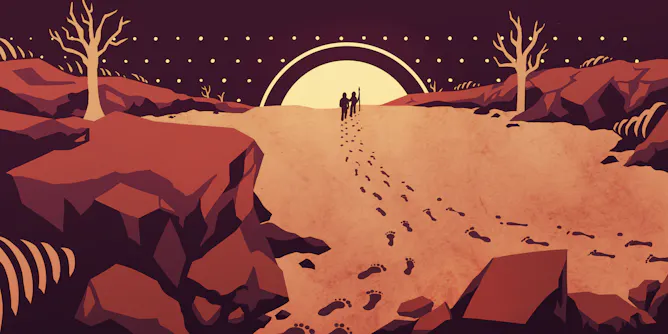
In July 2017, new research was published that pushed the opening chapters of Australian history back to 65,000 years ago.
Marcella Cheng/The Conversation
When did Australia’s human history begin?
The Conversation, CC BY16.6 MB(download)
Today's episode of Essays On Air, the audio version of our Friday essay series, seeks to move beyond the view of ancient Australia as a timeless and traditional foundation story.
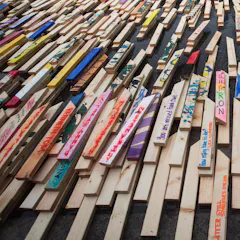
Wooden stakes representing the 2,224 confirmed overdose deaths in British Columbia - many of them young Indigenous people - over the last three years, are placed on the ground at Oppenheimer Park, in Vancouver on September 29, 2017.
(THE CANADIAN PRESS/Darryl Dyck)
Research shows that Indigenous women are at greatest risk of injury within Canada. Income, education and housing inequities play a role. So does systemic racism and post-colonial trauma.
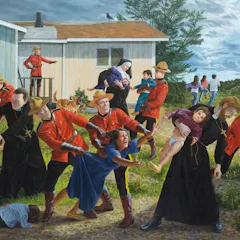
The Scream, by Kent Monkman (2016), is part of a traveling exhibition this year on colonized Canada: Shame And Prejudice: A Story Of Resilience.
Kent Monkman
A leading Indigenous academic says too many Canadians take ugly pleasure in being ignorant about Indigenous issues. It’s time for some straight talk about Settlers with Opinions.
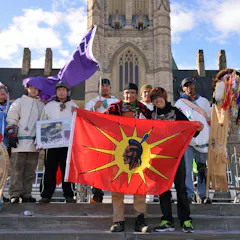
A group of youth walked 1600 kilometers to bring attention aboriginal issues in 2013 at Parliament Hill in Ottawa, Ontario. They hold up the Cree flag.
By Paul McKinnon/Shutterstock.com
Research shows that the Globe and Mail has created a script in which marginalized youth can only be dealt with as failures or criminals, impacting the way they are perceived in society.
There are many factors contributing to Indigenous suicide, occurring in a wide variety of contexts.
Dean Lewins/AAP
A new report recognises that no two Indigenous suicides are identical, then skilfully identifies common themes for informing responses that have the potential to save lives.
Chair of the Prime Minister’s Indigenous Advisory Council, Warren Mundine, speaking on Q&A, August 29, 2016.
Q&A
Chair of the Prime Minister’s Indigenous Advisory Council, Warren Mundine, told Q&A that $30 billion is spent every year on 500,000 Indigenous people in Australia. Is that right?
There are still many barriers to Indigenous participation and retention in the Australian workforce.
Tracey Nearmy/AAP
Detailed historical research on the colonial frontier unequivocally supports the idea that Aboriginal people were subject to attack, assault, conquest and subjugation: all synonyms for the term ‘invasion’.
Greens senator Sarah Hanson-Young, speaking on Q&A, February 15, 2016.
Q&A
From 2016, students will be able to study Aboriginal languages in high schools in New South Wales – but a clause in the design of the course means grades will not contribute towards ATARs.
Early intervention and diversion away from the criminal justice system can enable Aboriginal people with mental and cognitive disabilities to live with dignity.
AAP/Richard Ashen
Research suggests serious problems with the way Aboriginal women, particularly those with mental and cognitive disabilities, are “managed” by the criminal justice system.
Aboriginal people with mental and cognitive disability are ‘managed’ by police, courts and prisons due to a lack of appropriate community-based services.
Kate Ausburn/flickr
Australia’s high rates of imprisonment and re-imprisonment of Aboriginal people with mental and cognitive disabilities is not only shameful, it is entirely predictable and preventable.
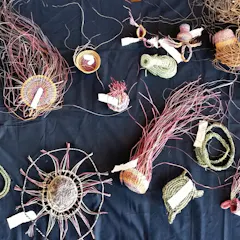
Weavings from Indigenous bush dyeing and weaving workshops.
Elizabeth Tunstall
Being rooted is different from being connected or even grounded. As we know from our mobile phones, connectivity can be fleeting. Grounding is only at surface layers. Being rooted goes as deep in the earth as above in the sky, providing greater stability.
European New Zealanders have embraced and preserved the Māori culture and language far better than European Australians.
Rob Chandler/Flickr
Up to 150 ‘communities’ in ‘remote’ Australia are threatened with closure. But do such terms put a gloss on what is, in reality, the closure of people’s homes?
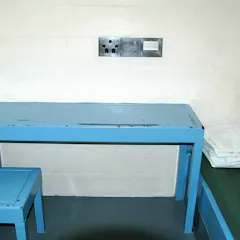
In the past decade, the number of people ending up in South Australian prison cells has grown at seven times the rate of the state population.
AAP/South Australian Correctional Services Department
Since 2004, the number of prisoners in South Australia has risen seven times faster than the state’s net population growth – and nearly doubled its rate of locking up Indigenous Australians.
We need policies that meaningfully include Aboriginal people in ways forward.
AAP Image/Amnesty International, Chloe Geraghty
Recently, Tony Abbott asserted the government couldn’t afford to fund the “lifestyle choices” of remotely-based Aboriginal people. But such communities could be key to meeting the demands of our future.
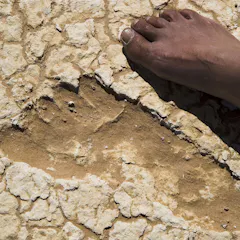
Among the early footsteps in Australia – The Mungo fossil footprints dating to 20,000 years ago.
Michael Amendolia
An Australian senator says the evidence on who should be recognised as the First Australians is only “conjecture”. So what does the evidence really say?
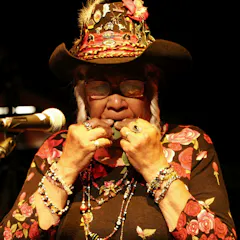
Roseina Boston onstage at the 2005 Melbourne International Arts Festival with the ensemble Pannikin.
(Courtesy Jon Rose, used with permission.)
The gumleaf is a wind instrument that comes with a steep learning curve. Today we celebrate the 80th birthday of one of its key proponents, Roseina Boston.