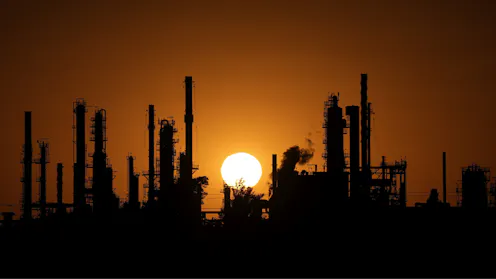
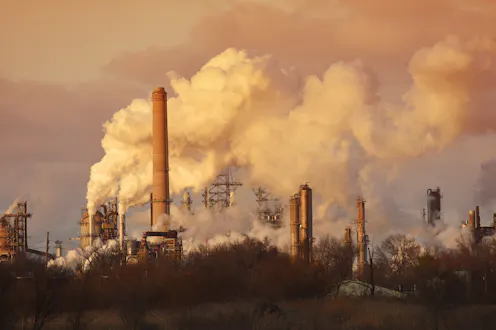
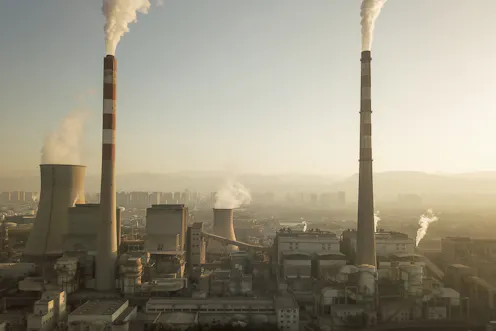
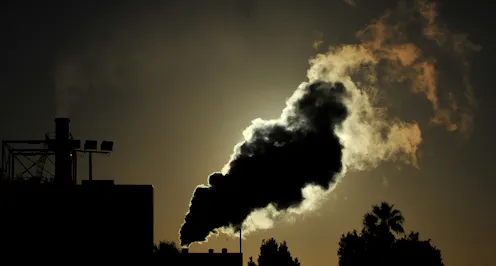
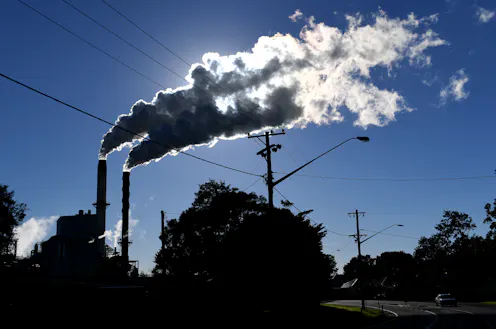
As world leaders gather at COP29 to consider reducing emissions, the latest global carbon budget shows CO₂ emissions from fossil fuels are still going up, not down, despite some promising signs.
Kencangnya laju emisi mengurangi jatah CO2 yang bisa kita lepaskan untuk membatasi suhu Bumi 1,5°C. Dengan tingkat emisi saat ini, bujet karbon kita tersisa 7 tahun lagi.
Les émissions de CO2 d'origine fossile continuent d'augmenter, mais le pic semble proche.
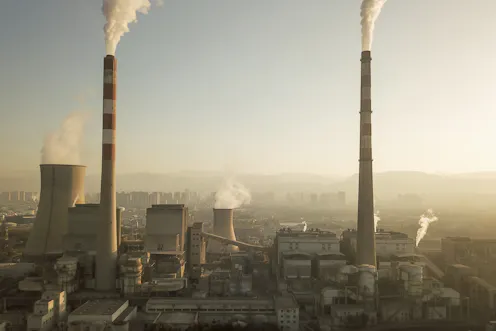
ChinaTopix/AP/AAP
Les quantités de CO₂ que nous pouvons encore émettre tout en respectant l’objectif de l’accord de Paris se réduisent à une peau de chagrin : au rythme de 2023, nous aurons épuisé ce budget carbone dans sept ans.
Record emissions are fast shrinking the remaining amount of carbon dioxide we can emit if we are to limit global warming. At current rates, we’ll use up the budget for a 1.5°C outcome in seven years.
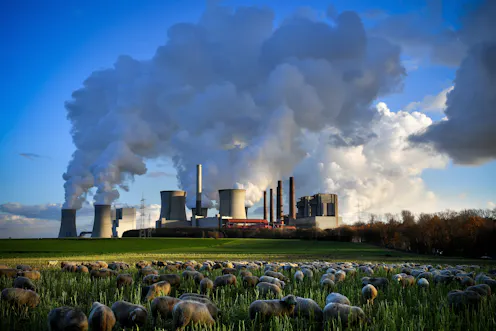
Le 12 novembre 2022, une jeune femme observe la mine de Garzweiler (Allemagne) où l’on extrait la lignite à ciel ouvert.
INA FASSBENDER/AFP
Aux niveaux actuels d'émissions, il y a 50 % de chances que la planète atteigne la hausse de température moyenne mondiale de 1,5 °C dans les 9 ans à venir.
Con los niveles actuales de emisiones, hay un 50 % de posibilidades de que el planeta alcance el 1,5 °C de aumento de la temperatura media global en sólo nueve años.
Après une forte baisse des émissions en 2020 due à la pandémie de Covid-19, 2021 témoigne d’une inquiétante reprise, souligne la nouvelle étude du Global Carbon Projet.
Preocupa especialmente la tendencia al alza a largo plazo de las emisiones de CO₂ procedentes de la quema de combustibles fósiles, que están lejos de llegar a cero en 2050.
The pandemic, along with other recent trends such as the shift towards clean energy, have placed us at a crossroad: the choices we make today can change the course of global emissions.
Coal emissions are falling, but gas and coal use are strongly rising around the world.
EPA/SASCHA STEINBACH
Carbon emissions will hit a record high for the second year in a row, but there is a small silver lining: the rate of emissions growth has slowed dramatically.
The Rhenish Brown Coal Field in Germany. Germany is one of 18 developed countries whose carbon emissions declined between 2005-2015.
SASCHA STEINBACH/AAP
Pep Canadell, CSIRO; Corinne Le Quéré, University of East Anglia; Glen Peters, Center for International Climate and Environment Research - Oslo; Jan Ivar Korsbakken, Center for International Climate and Environment Research - Oslo, and Robbie Andrew, Center for International Climate and Environment Research - Oslo
Reducing emissions doesn’t have to conflict with a growing economy, as these 18 developed nations show.
À l’occasion de la COP24, le Global Carbon Project publie une évaluation annuelle peu encourageante des rejets de CO2 pour l’année 2018.
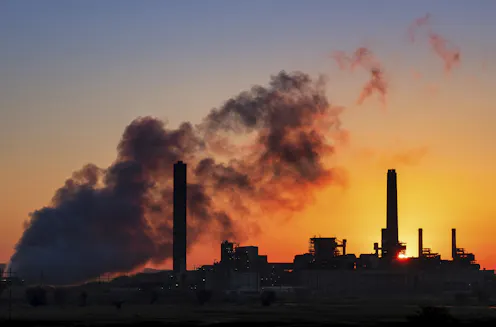
AAP Image/Mick Tsikas
Pep Canadell, CSIRO; Corinne Le Quéré, University of East Anglia; Glen Peters, Center for International Climate and Environment Research - Oslo; Robbie Andrew, Center for International Climate and Environment Research - Oslo, and Rob Jackson, Stanford University
La demande énergétique en hausse est l’un des facteurs explicatifs de cette tendance.
Pep Canadell, CSIRO; Corinne Le Quéré, University of East Anglia; Glen Peters, Center for International Climate and Environment Research - Oslo; Robbie Andrew, Center for International Climate and Environment Research - Oslo, and Rob Jackson, Stanford University
For the second year in a row global greenhouse emissions from fossil fuels have risen, putting 2018 on course to set a new record, according to an annual audit from the Global Carbon Project.
The growth in global carbon emissions has resumed after a three-year pause.
AAP Image/Dave Hunt
After three years in which global carbon emissions scarcely rose, 2017 has seen them climb by 2%, as the long-anticipated peak in global emissions remains elusive.