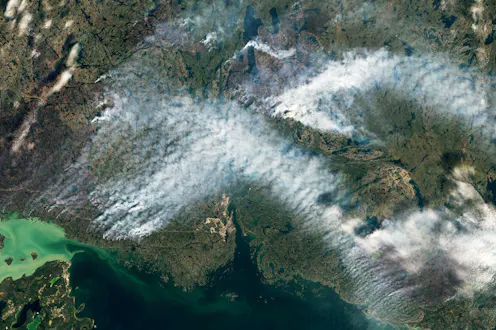
An aerial view of fires burning near Yellowknife, Canada, in 2023.
Lightworks Media/Alamy Stock Photo
Global carbon emissions from forest fires have increased by 60% over the past two decades, with the largest contributions coming from fires in Siberia and western North America.
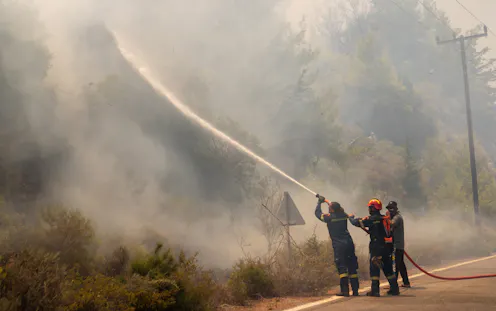
A state of emergency is in effect on the island of Rhodes.
EPA-EFE/Damianidis Lefteris
Climate change promotes ideal conditions for catastrophic fires, but the most drastic changes can still be avoided.
Stefan Doerr
La duración de la temporada de incendios ha aumentado en casi todas las regiones del mundo.
Stefan Doerr
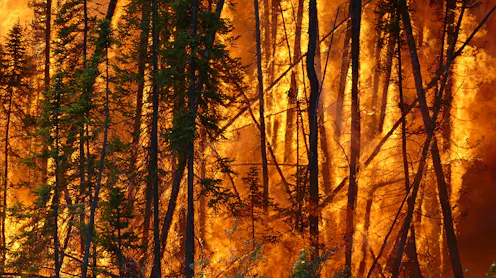
Fire weather reason – when wildfires are most likely to strike – has expanded almost everywhere.
AP Photo/J. David Ake, File
March 3, 2021
Pep Canadell , CSIRO ; Corinne Le Quéré , University of East Anglia ; Glen Peters , Center for International Climate and Environment Research - Oslo ; Matthew William Jones , University of East Anglia ; Pierre Friedlingstein , University of Exeter ; Robbie Andrew , Center for International Climate and Environment Research - Oslo ; Rob Jackson , Stanford University , and Steve Davis , University of California, Irvine
The global pandemic caused an unprecedented drop in global emissions. But this is likely to rebound as economies start to recover.
Shutterstock
December 11, 2020
Pep Canadell , CSIRO ; Corinne Le Quéré , University of East Anglia ; Glen Peters , Center for International Climate and Environment Research - Oslo ; Matthew William Jones , University of East Anglia ; Philippe Ciais , Commissariat à l’énergie atomique et aux énergies alternatives (CEA) ; Pierre Friedlingstein , University of Exeter ; Robbie Andrew , Center for International Climate and Environment Research - Oslo , and Rob Jackson , Stanford University
The pandemic, along with other recent trends such as the shift towards clean energy, have placed us at a crossroad: the choices we make today can change the course of global emissions.
Lucas Jackson/Reuters
May 19, 2020
Pep Canadell , CSIRO ; Corinne Le Quéré , University of East Anglia ; Felix Creutzig , Mercator Institute on Global Commons and Climate Change ; Glen Peters , Center for International Climate and Environment Research - Oslo ; Matthew William Jones , University of East Anglia ; Pierre Friedlingstein , University of Exeter ; Rob Jackson , Stanford University , and Yuli Shan , University of Groningen
New research reveals which sectors of the global economy fuelled the emissions decline during COVID-19. We have a narrow window of time to make the change permanent.
Lucas Jackson/Reuters
May 19, 2020
Pep Canadell , CSIRO ; Corinne Le Quéré , University of East Anglia ; Felix Creutzig , Mercator Institute on Global Commons and Climate Change ; Glen Peters , Center for International Climate and Environment Research - Oslo ; Matthew William Jones , University of East Anglia ; Pierre Friedlingstein , University of Exeter ; Rob Jackson , Stanford University , and Yuli Shan , University of Groningen
Una nueva investigación analiza los sectores económicos responsables de la caída global de emisiones debida a la COVID-19. Tenemos una pequeño margen de tiempo para hacer el cambio permanente.
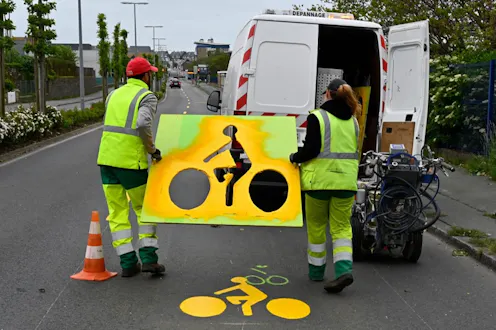
Le 11 mai 2020, à Saint-Malo, marquage d’une piste cyclable.
Damien MEYER/AFP
May 19, 2020
Pep Canadell , CSIRO ; Corinne Le Quéré , University of East Anglia ; Felix Creutzig , Mercator Institute on Global Commons and Climate Change ; Glen Peters , Center for International Climate and Environment Research - Oslo ; Matthew William Jones , University of East Anglia ; Pierre Friedlingstein , University of Exeter ; Rob Jackson , Stanford University , and Yuli Shan , University of Groningen
De tout récents travaux du Global Carbon Project montrent dans le détail les effets de la pandémie et du confinement sur l’économie mondiale.