• Professor and Tier 1 Canada Research Chair in Global Health Governance; Scientific Co-Director, Bridge Research Consortium, Simon Fraser University

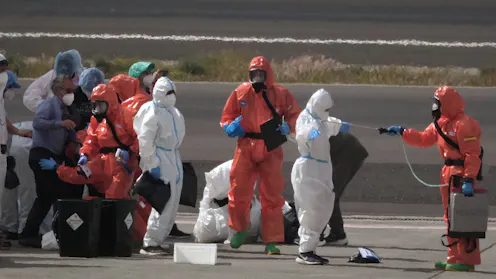
Passengers are sprayed with disinfectant by Spanish government officials before boarding a plane after disembarking from the hantavirus-stricken cruise ship MV Hondius at Tenerife airport in the Canary Islands, Spain, Sunday, May 10, 2026. (AP Photo/Arturo Rodriguez)

Planes, trains and pandemics: Lessons from COVID‑19 about travel risks posed by hantavirus and Ebola

Recent outbreaks of Hantavirus and Ebolavirus raise concerns about risks linked to travel, with responses varying between countries. COVID-19 offers lessons for effective approaches to public health.
A child receives a drop of vaccine from a medical worker during a polio immunization campaign at a school in Denpasar, Bali, Indonesia in July 2024. (AP Photo/Firdia Lisnawati)

It’s World Immunization Week. How prepared is Canada if vaccines are needed for a new pandemic?

Vaccines have saved more than 154 million lives worldwide over the past 50 years. World Immunization Week is a timely reminder of important ongoing work on vaccines in Canada.

Medical staff look out from a window at Kenyatta National Hospital in Nairobi in March 2021 as officials prepare for a ceremony to commence the country’s first coronavirus vaccinations provided through the global COVAX initiative. (AP Photo/Ben Curtis)

Why it’s a critical time for Canada to renew its commitment to global health co‑operation

Building on a storied history of engagement that supersedes partisan politics, there is no time to lose for Canada to strategically renew its role in global health.
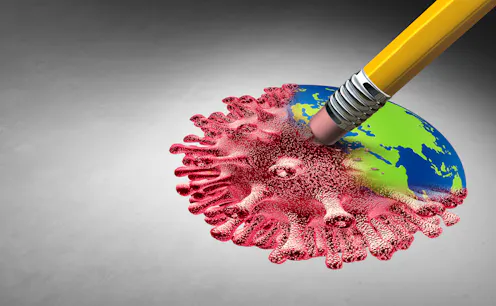
The World Health Organization has declared an end to COVID-19’s status as a public health emergency of international concern. (Shutterstock)

Learning from COVID‑19: The global health emergency has ended. Here’s what is needed to prepare for the next one

After previous public health emergencies likes SARS and H1N1, there was renewed investment in pandemic preparedness, but it was not sustained. We cannot make the same mistake after COVID-19.
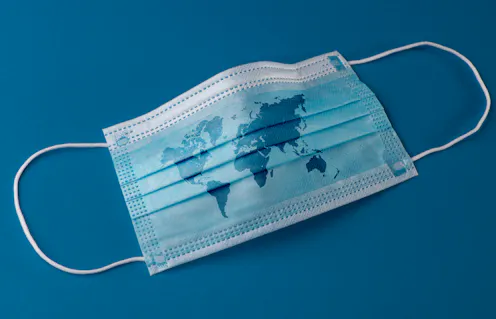
The degree to which Canadians support effective international co-operation, as essential to future pandemic preparedness and response, will shape Canada’s positioning on the draft international pandemic treaty. (Shutterstock)

The WHO’s international pandemic treaty: Meaningful public engagement must inform Canada’s negotiations

As negotiations for an international pandemic treaty get underway, public engagement is in the best interests of Canadians. Here is how the federal government is consulting affected populations.
Cathay Pacific crew members who worked on a flight from Hong Kong arrive at Vancouver International Airport. Canada now requires air travellers from China, Hong Kong and Macau to have a recent negative COVID-19 test result. THE CANADIAN PRESS/Darryl Dyck

Canada’s new COVID test rules: Targeting travellers from China will not stop globally circulating Omicron subvariant

Canada’s new COVID-19 testing requirement for travellers arriving from China is unlikely to prevent the spread of new subvariants.
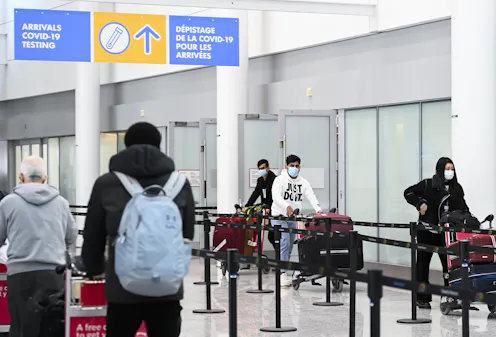
Arriving travellers from an international flight follow signs toward COVID-19 testing at Pearson International Airport in Toronto in February. THE CANADIAN PRESS/Nathan Denette

​​COVID‑19 and border restrictions: Here’s what the parties’ election platforms say about controlling the fourth wave

The federal election is taking place during a fourth wave of COVID-19, and border management remains crucial to controlling the pandemic. Here’s how each major party would manage travel restrictions.
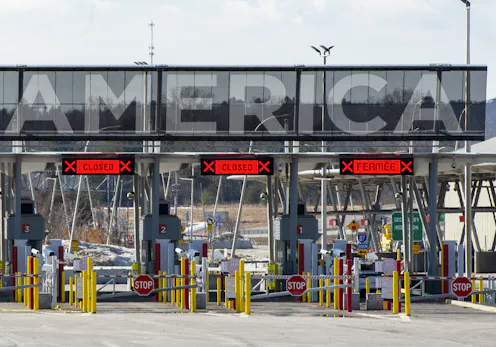
Les responsables fédéraux ont maintes fois vanté les mesures prises par le Canada aux frontières pendant Covid-19 comme étant parmi les plus strictes au monde. La Presse Canadienne/Ryan Remiorz

Le Canada doit corriger sa gestion des frontières pour éviter une quatrième vague de Covid‑19

La pression monte pour la réouverture de la frontière canado-américaine, mais il y a des risques. La façon dont ils sont gérés peut faire la différence entre une reprise de la pandémie ou pas.
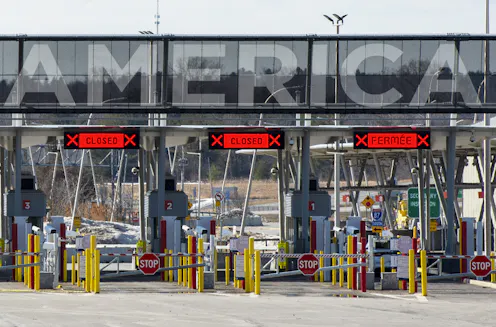
Federal officials have repeatedly touted Canada’s border measures during COVID-19 as among the most stringent in the world. THE CANADIAN PRESS/Ryan Remiorz

Canada needs to fix its border management now to prevent a fourth wave of COVID‑19

Pressure is mounting to reopen the Canada-U.S. border, but there are risks. How well those risks are managed may be the difference between pandemic recovery or a fourth wave of COVID-19.
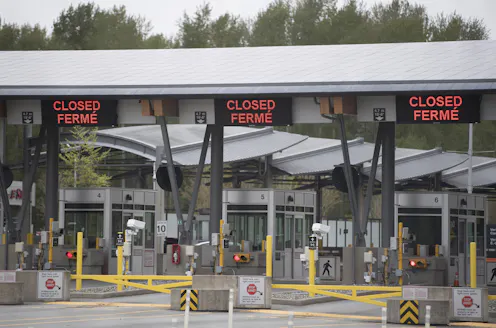
Part of Canada’s land border with the United States is closed at the Peace Arch border crossing in Surrey, B.C. on April 28, 2020. (THE CANADIAN PRESS/Jonathan Hayward)

Closing some of the U.S.‑Canada land border crossings could help control the COVID‑19 pandemic

Current travel restrictions aren’t applied uniformly for air and land travellers. Similar restrictions need to be applied to land border crossings to curb the spread of COVID-19 and its variants.
A guest looks out from a Sheraton hotel window in Mississauga, Ont., on Feb. 22, 2021, as new air travel rules come into effect in Canada. THE CANADIAN PRESS/Cole Burston

COVID‑19 hotel quarantine: Exemption for ‘essential’ medical travel confuses doctors, patients

Canadian government travel restrictions are an attempt to curb the spread of COVID-19 variants. But vague language around exemptions for medical travel may confuse the physicians who can grant them.
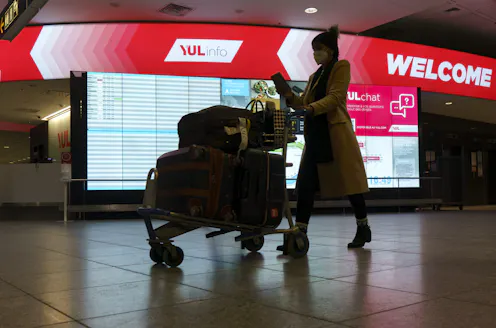
Une passagère passe par l'aéroport Montréal-Trudeau de Montréal, le jeudi 7 janvier 2021. Les cas de Covid-19 rapportés par les voyageurs sont sous-estimés par la Santé publique. La Presse Canadienne/Paul Chiasson

Les cas de Covid‑19 liés aux voyages sont sous‑estimés au Canada. Voici pourquoi

Les restrictions de voyage annoncées visent à freiner la propagation des variantes du coronavirus. Mais le système actuel ne collecte pas systématiquement ou rigoureusement suffisamment de données.
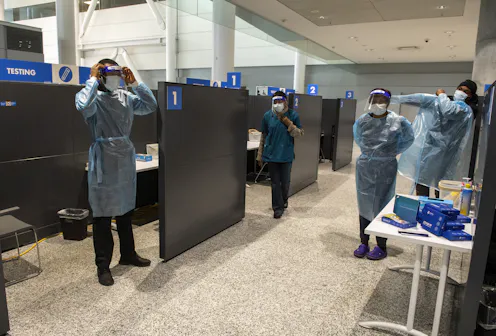
Workers prepare to greet passengers at the COVID-19 testing centre in the international arrivals area at Pearson Airport in Toronto on Jan. 26, 2021. THE CANADIAN PRESS/Frank Gunn

Why Canada doesn’t know how many COVID‑19 cases are linked to travel

Recently announced travel restrictions are intended to curb the spread of COVID-19 variants. However, we need to do a better job of tracking arrivals into the country.

Contact Kelley for

  • Media request
  • Speaking request
  • Consulting / Advising
  • Research collaboration