
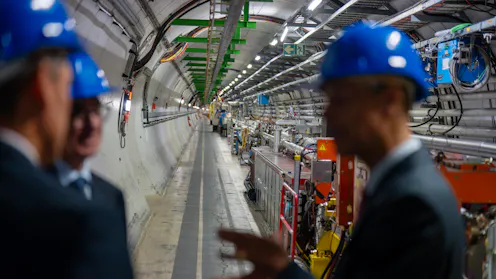
Particle accelerators aren’t just for testing the Standard Model. They’re also used to diagnose and treat disease and study world history.
- Professor of Nuclear Physics, Michigan State University
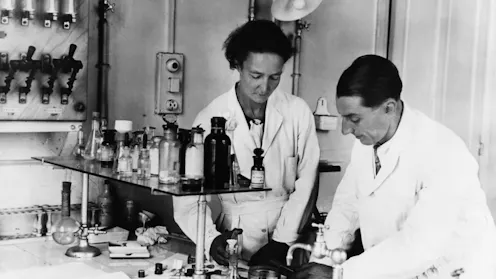
Marie Curie’s daughter Irene continued her family’s Nobel legacy by discovering artificial radioactivity.
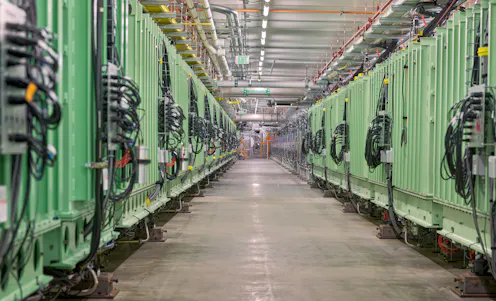
All the oxygen in your body is thanks to magic numbers of protons and neutrons in the nucleus.
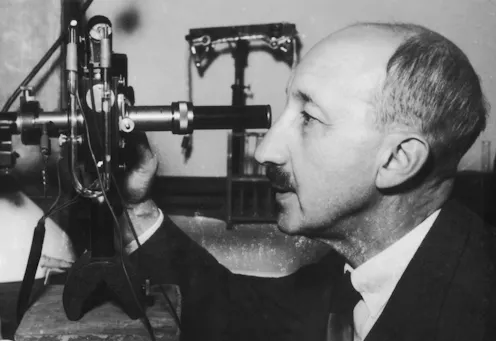
Some Nobel Prize-winning ideas originate in strange places, but still go on to revolutionize the scientific field. George de Hevesy’s research on radioactive tracers is one such example.
A new particle accelerator has just begun operation. It is the most powerful accelerator of its kind on Earth and will allow physicists to study some of the rarest matter in the universe.
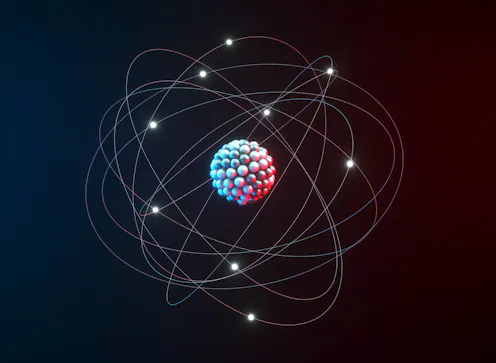
Nuclear isomers are rare versions of elements with properties that mystified physicists when first discovered. Isomers are now used in medicine and astronomy, and researchers are set to discover thousands more of them.
Alongside their famous dangers, radioactive materials have many beneficial uses. With as many more predicted as have already been discovered, nuclear physicists are searching for more isotopes.

People long assumed all the elements we see now were created during the Big Bang. But on May 2, 1952, an astronomer reported spotting new elements coming from an old star and changed our origin story.
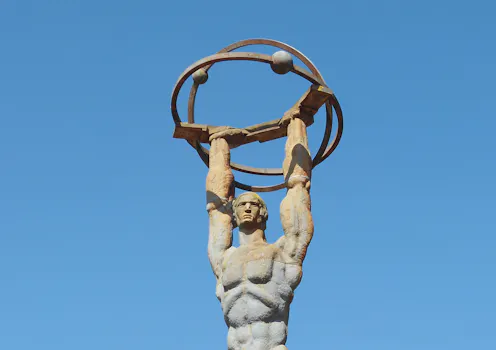
By figuring out fission, physicists were able to split uranium atoms and release massive amounts of energy. This Manhattan Project work paved the way both for atomic bombs and nuclear power reactors.
Contact Artemis for
- General
- Media request
- Speaking request
- Research collaboration
- Location: East Lansing, Michigan, U.S.
- Website
- X (formerly Twitter): @ArtemisSpyrou
- Article Feed
- Joined
