

The show raises critical questions about how the UK treats young offenders.
Articles on Young offenders
Displaying all articles

The brains of young people are developing until about age 25, limiting their ability to make rational decisions and control impulses. Youth justice policies that ignore this risk failure.

Young people’s voices need to be heard if we are to solve the knife crime crisis.

Vulnerable young people have been failed by austerity policies that have decimated the services meant to protect them.

Former young offenders can be uniquely well-equipped to support teenagers at risk of getting caught up in crime.

In Alberta, an alternative initiative sees youth who commit non-violent crimes sentenced to 25 hours of chess instruction with a University of Lethbridge professor.
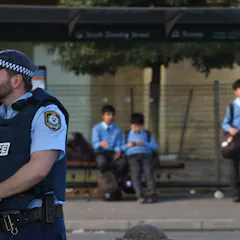
The police in schools model abolished in Victoria in 2006 represents an outdated, paternalistic approach to youth crime and would not likely reduce youth crime rates if we brought it back now.

A judge has ruled that placing a 16-year-old in solitary confinement breached his human rights.

Because it’s not just children in school who need to know how to put a condom on.

Two teenagers have been sentenced to life for a double murder. But their crime is extremely rare.

Changes that would widen the gulf between Australian practice and international standards should be avoided at all costs.

Prison-style regimes are not safe for children – and especially for those who are already vulnerable.

Given the chance to be creative, young people shine.

Last month, Queensland’s Attorney-General Jarrod Bleijie called for the public naming of all youth who appear in court. Echoing practices from the deep south of the USA where t-shirts, signs outside homes…
Top contributors
-

Senior Lecturer in Criminology, Edge Hill University
-
Research Fellow in Nursing and Midwifery, Queen's University Belfast
-
Senior Lecturer in Applied Health and Social Care, Edge Hill University
-
Assistant Professor of Educational Psychology, University of Lethbridge
-
Assistant Professor, Criminology, Bond University
-
Senior Lecturer in Criminology, Deakin University
-
Professor of Criminology, Loughborough University
-
Senior Lecturer in Inclusive Education, Goldsmiths, University of London
-
Professor (Practice), Faculty of Business and Economics, Monash University
-
Senior Lecturer in Criminology, The University of Melbourne
-
Associate Professor of Nursing, University of Lethbridge
-
Lecturer in Social Work, University of Salford
-
Senior Lecturer in Criminology, University of Kent
-
Senior Lecturer in Criminology and Criminal Justice, University of Manchester
-
Professor of Law, Auckland University of Technology