
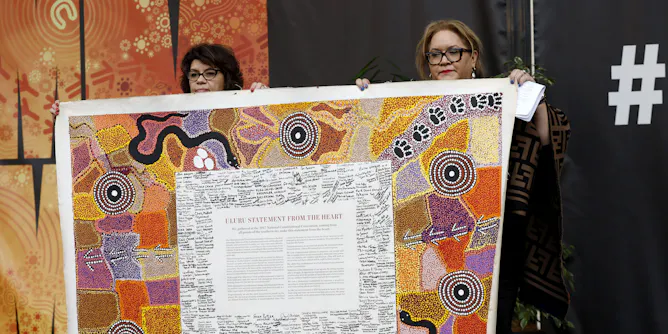
Two big ethical questions have emerged during the Voice to Parliament campaign: is it fair non-Indigenous people will get the majority say? And is it fair one group will get something others don’t?
Articles on Voice questions answered
Displaying all articles
Mis- and disinformation about the Voice to Parliament proposal are rife. Here, experts address 10 of the most common myths.
Legislation is an unsatisfactory way to institute a Voice to Parliament because, among other reasons, it would make the body insecure and vulnerable to the whims of different governments.

The Uluru Statement from the Heart calls for truth-telling as a crucial step towards reconciliation. What does this process involve, and what are the potential promises and pitfalls?
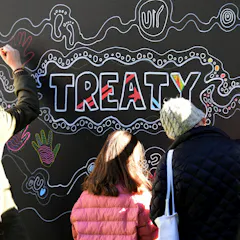
Indigenous people have been calling for a treaty for generations. But what would it actually look like and what would it do?
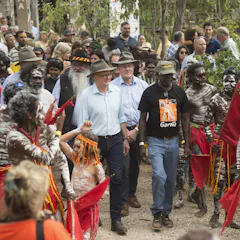
We now know the wording of the Voice referendum and proposed constitutional amendment. But what may have been forgotten is how we got here in the first place – and why it matters.

Even though there is strong Indigenous representation in parliament, this does not guarantee Indigenous communities a say in laws and policies made on their behalf.

A Voice to Parliament will not fix every problem facing Aboriginal and Torres Strait Islander peoples. But it is an important step towards moving the nation to truth telling and beyond.
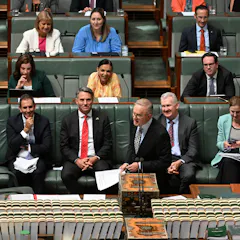
The Voice to Parliament is an advisory body, which means neither parliament nor the government is legally required to give effect to its representations.
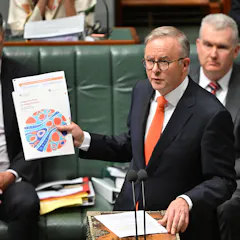
There has been much debate about the “details” of the Voice to Parliament, but the referendum is on the principle.
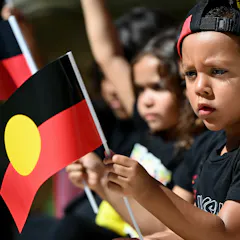
The Uluru Statement from the Heart will give us new meaning to the expression.
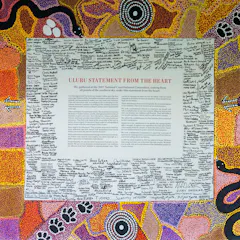
Some Australians have dismissed a Voice to Parliament as inconsequential. That argument is mistaken.
Top contributors
-

Professor of Law, UNSW Law School, UNSW
-
Lecturer, Griffith Law School, Griffith University
-
Associate Professor, Faculty of Law & Justice, UNSW
-
Lecturer, Faculty of Law, University of Technology Sydney
-
Adjunct Professor in Law, Adelaide University
-
Professor, School of Social and Political Sciences, Director, The (so-called) Australian Centre, The University of Melbourne
-
Associate Professor, UNSW
-
Professor and Head of the Department of Philosophy, and Co-Director of the Macquire University Ethics & Agency Research Centre, Macquarie University
-
Professor, Australian and Aboriginal History, Faculty of Arts, Design and Architecture, Convenor: Indigenous Land & Justice Research Group, UNSW
-
Professor Emerita in Constitutional Law, University of Sydney
-
Faculty of Arts Indigenous Postdoctoral Fellow, Indigenous and Settler Relations Collaboration, The University of Melbourne
-
Professor of law, Australian National University
-
Associate Professor and Director of the Radical Centre Reform Lab at Macquarie University Law School, Macquarie University
-
Professor of Medicine, Monash University
-
Associate Professor in Law, Curtin University