
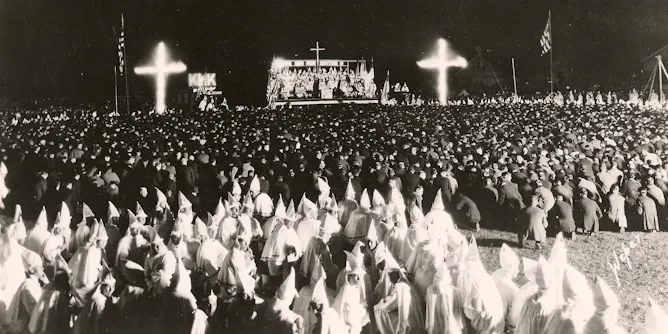
Most of the Klan’s victims were African American, but many other groups have been targeted during the hate group’s century and a half of history.
Articles on US history
Displaying 141 - 160 of 574 articles
Two and a half centuries later, some things haven’t changed.
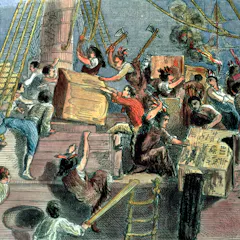
An attack on private property angered Colonial leaders as much as the British public – but a strong reaction from Parliament hardened the positions of the opposing sides, making compromise impossible.

Shoplifting has been hyped as a driver of chain-store closures, but did these companies ever really understand urban environments in the first place?
What’s in a name? A lot, if you’re an Audubon’s Oriole or a Townsend’s Solitaire.
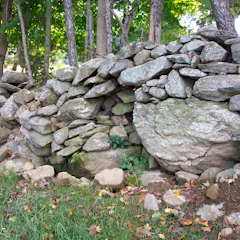
New England has thousands of miles of stone walls. A geoscientist explains why analyzing them scientifically is a solid step toward preserving them

This isn’t the first time that US authorities have criminalized civil disobedience or framed grassroots organizing as a conspiracy.
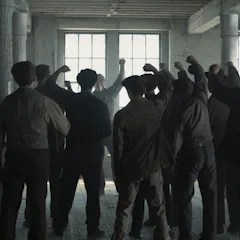
Old and new money come into conflict in this American ‘prequel’ to Downton Abbey.

Rather than have students memorize names and dates, this history curriculum invites students to grapple with real-life issues faced by people from the past.
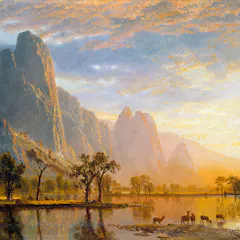
The idea of Manifest Destiny inspired Americans to push west, leading to the creation of the first national parks. But those beliefs spelled removal for many Native American groups.
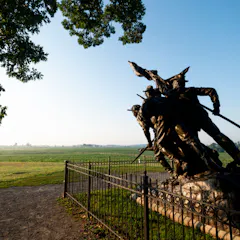
How should opposing armies be commemorated on a battlefield? Gettysburg offers an especially interesting example of today’s debates over Confederate monuments.

Until 1906, no US president had ever traveled abroad in office. Then Teddy Roosevelt demonstrated the power of showing up.
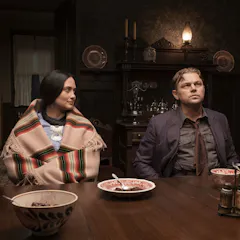
David Grann’s account of a sensational murder investigation, the basis for Martin Scorsese’s latest film, delves into the mythologies of the old Wild West
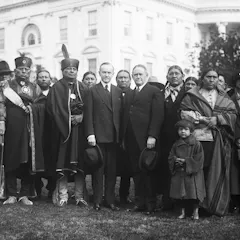
The Osage murders of the 1920s are just one episode in nearly two centuries of stealing land and resources from Native Americans. Much of this theft was guided and sanctioned by federal law.
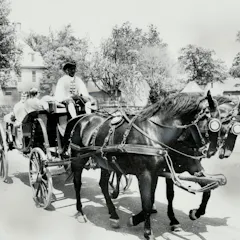
Though it is a fact that some enslaved people learned valuable skills, it’s a myth that they had the same path of upward mobility that white laborers enjoyed.
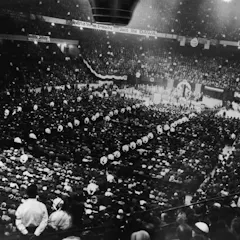
Two social scientists analyzed periodicals from US religious leaders in 1935 to determine what factors influenced groups’ sympathy, ambivalence or outrage about Hitler and Nazi Germany.

From semitropical playgrounds to life-endangering climate risks: Going back over a century, California’s and Florida’s growth has been predicated on climate – and promises of the good life.

Founded in 1959, the membership group Trout Unlimited has changed the culture of fly-fishing and mobilized members to support conservation. Could its approach work for other social problems?
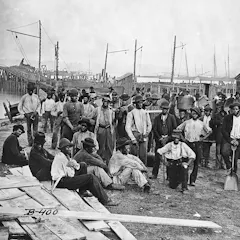
While a Florida curriculum implies that enslaved Africans ‘benefited’ from skills acquired through slavery, history shows they brought knowledge and skills to the US that predate their captivity.

American history can partly explain why some Americans have come to believe only Donald Trump has their interests at heart, and will vote for him — and fight for him — despite his indictments.
Top contributors
-

Professor of History, Penn State
-
Associate Professor of Instruction, The University of Texas at Austin
-
Emeritus Professor of Life Sciences, Arizona State University
-
Distinguished Professor and Professor of the Humanities, USC Dornsife College of Letters, Arts and Sciences
-
Professor of Urban Policy and Planning, Hunter College
-
Distinguished Professor of History and Environmental Studies, Penn State
-
Professor of Journalism, Indiana University
-
Professor of History and Provost Emeritus, Binghamton University, State University of New York
-
Visiting Assistant Professor of History, Miami University
-
Associate Professor of History, Deakin University
-
William Nelson Cromwell Professor of Jurisprudence and Political Science, Amherst College
-
Chester D. Tripp Professor of History, Yale University
-
Professor Emeritus of Political Science, University of Utah
-
Professor of History, University of New Hampshire
-
Professor of History, McGill University