
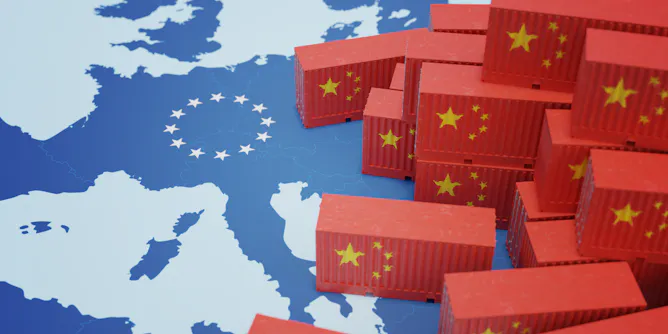
The US and China have extended their trade truce till January. Meanwhile, EU-China export/import imbalances persist with sticking points, including voluntary export curbs and industrial policy reform.
Articles on US-China
Displaying 1 - 20 of 173 articles

Nations that lead the development of open-source technology will have a strategic edge for decades to come.
The German chancellor, Friedrich Merz, has called for a new Plaza accord to address what he sees as China’s unfair trade practices.

A parade of global leaders through Beijing is good for optics. But this visibility does not necessarily translate into global leadership.

Washington and Beijing are locked in superpower competition. That is not going to change.

The Greek historian recounted the danger of a rising power challenging an established one.

A cultural historian of modern China explains the meaning behind some of the venue choices during President Donald Trump’s visit to Beijing.

While the Trump-Xi summit led to few tangible returns, the two leaders did not clash and agreed to continue talking.

On the issue of contested island, both US and China appear happy to keep with the status quo. Meanwhile, the presence of US Defense chief hints at Washington’s desire for a military ‘hotline.’
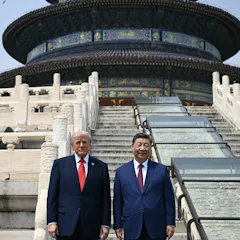
The Chinese president warned of possible conflict if the issue of Taiwan is ‘handled poorly’.

Vladimir Putin will see his relevance and leverage diminished by more stable US-China relations.
Both sides need to realise there will be no ‘winner’ in their rivalry. Instead, they can learn to coexist through mutual restraint and continued engagement.

Taiwan, trade and AI regulation are on the agenda. But will there be progress on any of these issues during Beijing sit-down?

Economist Jiao Wang talks to The Conversation Weekly podcast about the way China has diversified its export markets away from the west.
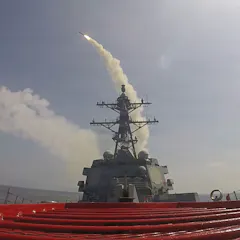
Measuring US weapons stockpiles sheds light on future constraints and what Russia and China may learn from the Iran war.

Scientific innovation has been driving US economic growth for decades. Losing that edge means losing access to the technologies and brainpower that come with it.
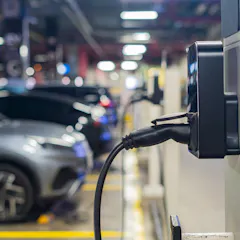
If China sets the international rules for the global green economy it could be in a very strong position. That’s not far off.

China accounts for more than 80 per cent of global battery production. It’s highly unlikely the U.S. can reduce China’s role in the production and processing of critical minerals.
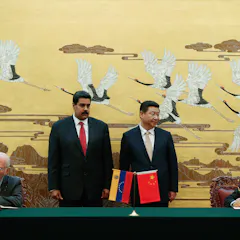
Beijing may benefit from the US retreat from international norms and a vision of a world split into ‘sphere of influence.’

The men and women tasked with implementing policy are governed by the same incentives and constraints − whether in Beijing or Washington.
Top contributors
-

Professor of Law, University of Waikato
-
Lecturer in International Relations, University of East London
-
Professor of International Relations, University of Otago
-
Professor of Political Science, Boise State University
-
Professor of International Security, University of Birmingham
-
Assistant Professor of Business Economics, University of Nottingham
-
Professor of Chinese Politics; Director, Lau China Institute, King's College London
-
Associate Professor of History and Asian Studies, University of Maryland, Baltimore County
-
Professor of Political Science, University at Buffalo
-
Associate Professor of International Politics and Principal Research Fellow, Institute for Indo-Pacific Affairs (Christchurch), University of Otago
-
Professor of Political Science, Kansas State University
-
Distinguished Professor, Arthur J. Gosnell Professor of Economics, & Head, Department of Sustainability, Rochester Institute of Technology
-
Associate Professor of Film and Media Studies, Arizona State University
-
University Professor of Electrical and Computer Engineering, Iowa State University
-
Associate Professor of Political Science, Westminster College