
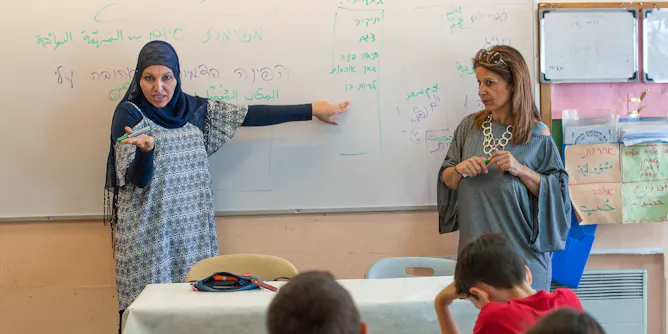
Israel’s divided education system – based on nationality and religious observance – serves as a test case for exploring controversial education policies in America.
Articles on Uncommon Courses
Displaying 21 - 40 of 85 articles
Trial lawyers, like artists, have to connect with different audiences and push them to look at legal issues, people and ideologies in new ways.
A scholar of Tibetan Buddhism discusses how she challenges her students to rethink their preconceived notions of death, the afterlife and the concept of the ‘other.’

Two professors explain why and how their approach creates a richly textured understanding of the American Dream.

The study of martial arts involves physical training − but also raises larger questions about ethics and what justifies the use of force.

A course explores how ancient apocalypses find their way into movies and TV shows.

Political polarization is at an all-time high. Students part of this University of San Diego Kroc School of Peace Studies course examine up close the country’s divides during their journey.

Can stories about detectives from days gone by help students learn to think more critically? An English lecturer provides clues through a course that features novels about sleuths from a bygone era.

Teachers who took the course reported less depression and better sleep − and needed fewer sick days.

Using films like “The Matrix,” a sociology course examines how factors beyond our control shape the world we live in − in fact and in an imagined future.

Alcohol is a window into American history, from 17th-century rum production to young people’s declining interest in drinking today.

With 100 hours aboard Amtrak trains, students learn about sustainable travel and destination tourism, using cities along the routes as living laboratories.

Science fiction can be thought of as a film negative of history – a back door into what used to worry people and what gave them hope.

Students can play to their strengths in this anthropology course designed to teach them how to present research findings in ways other than a peer-reviewed paper.

Parks around campus at this university become a place for law students to produce prose and draw parallels between nature and the law.

Humans aren’t the only species to consider when constructing new buildings. This course teaches students to take animals into account as well.

Cats provide a purr-fect introduction to science topics, including ecology, evolution, genetics and behavior.

A political scientist describes a class he’s designed to help counter cynicism and distrust.

In asking how Buddhism gained such a vast material presence, the course helps students understand how a religion manages to survive over time.

Giving and receiving criticism can be difficult. This class tries to make it easier.
Top contributors
-

Director of Artificial Intelligence Initiatives, University of Michigan
-
Associate Professor of Mathematical and Computational Sciences, University of Toronto
-
Teaching Professor of Computer Science and Engineering, University of California, San Diego
-
Professor of English, John Carroll University
-
Associate Professor of Civil and Environmental Engineering, Georgia Institute of Technology
-
Assistant Professor of Philosophy, United States Air Force Academy
-
Assistant Professor of the Practice in Religion and History and Associate Director of the Center for the Study of Guns and Society, Wesleyan University
-
Professor of Sociology, Wake Forest University
-
Holcim (US) Professor of Sustainable Enterprise, Ross School of Business, School for Environment & Sustainability, University of Michigan
-
Associate Professor of Sociology, University of Maryland
-
Assistant Professor of Art History, Binghamton University, State University of New York
-
Professor and Chair, Department of Psychology, State University of New York Cortland
-
Professor of Management & Organizations, University of Michigan
-
Postdoctoral Fellow in Religion, Bowdoin College
-
Professor of Religion and Art History, Rice University