
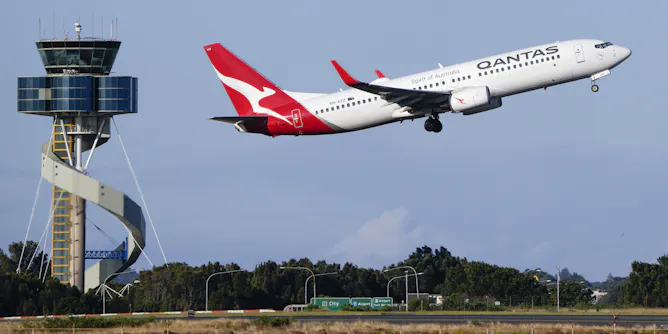
New research suggests global warming is increasing the frequency and intensity of wind gusts from thunderstorm downbursts, with serious consequences for air travel.
Articles on Turbulence
Displaying all articles

A shallower pool may have subtle effects on swimmers’ performance – but perhaps not the ones you’d think.

With severe injuries from turbulence on a recent Singapore Airlines flight, questions abound over why airplanes encounter this phenomenon and whether climate change really will make it worse.
Air travel is safer than you might think, despite the publicity surrounding the recent Singapore Airlines incident. Here’s what’s going on to distort your perception of risk.

A football’s dimensions, pressure and texture affect its aerodynamics, i.e. the forces exerted by the air on the ball as it flies.

An anatomist explains why turbulence on flights makes us feel so ill and disoriented.
Currents can carry that deep ocean heat hundreds of miles to surface again at distant shores.

When something disrupts the smooth, laminar flow of high-altitude winds, your flight might get a little bumpy.
You might be familiar with turbulence as you experience it on a plane, or as scholars describe combustible forces of social change. But understanding how it operates is far more complex.

Meteorology researchers across the country are prepping experiments for the mini-night the eclipse will bring on August 21 – two minutes and 36 seconds without the sun in the middle of the day.

Major airports around the world will see more frequent flight restrictions in the coming decades because of increasingly common hot temperatures.
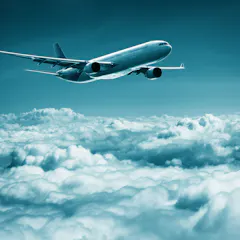
It’s all to do with the ‘Swiss cheese model’.
Top contributors
-

Associate Research Scientist, Center for Climate Systems Research, Columbia University
-
Professor, History, Dean of Arts, Australian Catholic University
-
Associate Professor, Epidemiology, Deakin University
-
Director, Gender and Women's History Research Centre, Australian Catholic University
-
Space and Aerospace Engineering Lead, University of Lancashire
-
Neukom Institute Postdoctoral Fellow, Dartmouth College
-
Professor of Mechanical Engineering, The University of Melbourne
-
Professor/Head of Aviation, CQUniversity Australia
-
Associate Professor of Geography, University of South Carolina
-
Professor, School of Geography, Earth and Atmospheric Sciences; ARC Centre of Excellence for the Weather of the 21st Century, The University of Melbourne
-
Associate Professor, UNSW
-
Professor of Anatomy, Lancaster University
-
Associate Professor of Climate Science, Brandeis University
-
Ph.D. Candidate in Physical Oceanography, University of California, San Diego
-
Professeur adjoint, École de technologie supérieure (ÉTS)