

Rejoining the Trans-Pacific Partnership would boost trade in Southeast Asia, counter China and help show the world the US is back.
Articles on Trans Pacific Partnership
Displaying 1 - 20 of 68 articles
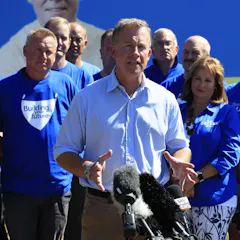
Malcolm Turnbull says people won’t be casting a national vote until the due time of 2019 – although Labor is working on contingency plans for this year in case he changes his mind or is foxing.

The new TPP means fewer barriers for Australian exports, but there a number of loose ends – not least if the United States decides to rejoin.
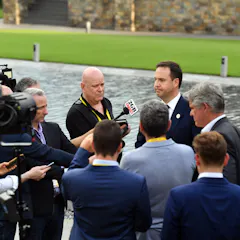
Many provisions in the Trans-Pacific Partnership have been suspended after the United States pulled out. But there’s still much to debate about the regional free trade agreement.
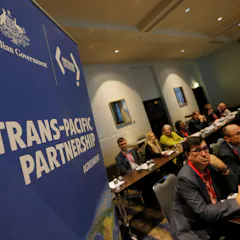
Negotiators from 11 countries have been racing to resurrect the near-dead Trans-Pacific Partnership Agreement before the Asia-Pacific Economic Cooperation (APEC) summit this weekend.

NAFTA renegotiations may see provisions from the Trans-Pacific Partnership revive like zombies. We must remember their failures - on income inequality, labour and environmental protection.
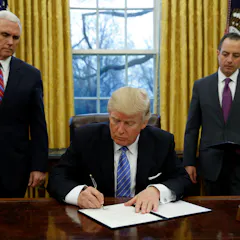
The TPP should still bring enough benefits for the remaining countries to make it worthwhile to go through the trouble of enacting it.
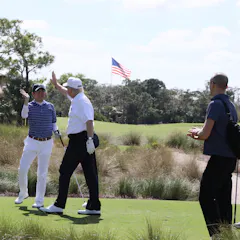
Japanese Prime Minister Shinzo Abe may have just demonstrated to other world leaders how to possibly approach President Donald Trump.
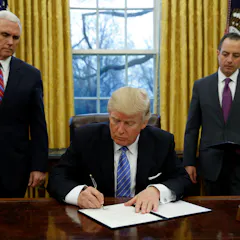
The agreement could be as good as dead, if, instead of pushing ahead without the US, its members decide to explore bilateral trade agreements with the country.

Many of the US’s current and mooted free trade negotiations are now dead in the water, but that doesn’t mean it’s game over for free trade.
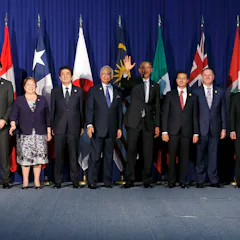
Security and economic interests, in the guise of the 12-member Trans-Pacific Partnership (seven of which hail from the Asia-Pacific), are causing anxiety among US friends and allies.

To create a resilient domestic economy, certain features of the “old” economy may still be required in China.
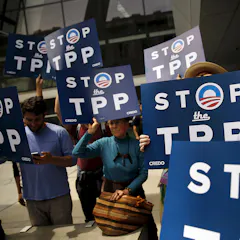
The Trans-Pacific Partnership is one of President Obama’s biggest accomplishments of his second term. Can it survive the anti-trade tide in the race to replace him?

Southeast Asia’s biggest economy is eyeing to join the US-led Trans-Pacific Partnership (TPP) trade deal, already signed by a dozen countries, including Australia.
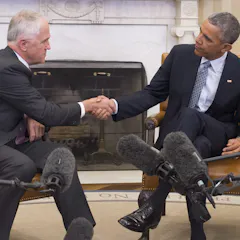
2016 will be a year of transitions in the Australia-US relationship. Against a backdrop of change are three important issues: the fight against Islamic State, China, and passage of the TPP.

An open letter signed by security experts from around the world is calling on governments to protect encryption rather than undermine it in a quixotic attempt to tackle terrorism.

Australia’s plain packaging win over Philip Morris will kill the ISDS bogeyman.
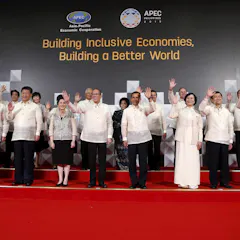
Opposition against Investor-State Dispute Settlement clauses seems likely to fall away as Asian economies flock to the TPP.
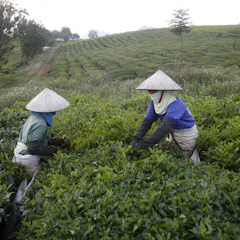
The Trans-Pacific Partnership has been described by its backers as a boon for development. But with no concrete commitments, nor any mention of climate, it is really at odds with the UN development agenda.

TPP negotiations have been covered in secrecy, and now as details have been released it only shows a wider democratic deficiency.
Top contributors
-

Professor of Public Health, La Trobe University
-
Professor in Intellectual Property and Innovation Law, Queensland University of Technology
-
Professor of Law, University of Sydney
-
Fellow, Australian National University
-
Research Director, The University of Western Australia
-
Associate Professor of Political Science, Georgia State University
-
Professor of Politics, McMaster University
-
Professor of Law, University of Newcastle
-
Media Specialist, Department of Computing and Information Systems, The University of Melbourne
-
Professor of Economics, Dean of UWA Business School, The University of Western Australia
-
Industry Professor and Chief Economist, University of Technology Sydney
-
Adjunct professor, Department of Health Policy & Management, George Washington University
-
School of Social Sciences, Monash University
-
Honorary research associate, University of Sydney
-
Professor of Marketing and International Business, Michigan State University