

Programs took different approaches to helping young viewers grapple with the horrors of the 9/11 terrorist attacks – lessons that still apply in today’s media environment.
Articles on Tragedy
Displaying all articles

Favouring restraint over spectacle, these stories offer intimate portraits of people shaped by history, disappointment, tragedy, grief and the long shadows of secrecy.

In the right context, films can move across many different genres in the span of their lifetime, depending on the audiences that watch them.

Fraudulent crowdfunding can cause distractions and further distress for victims of a tragedy.

In general, an ageing population puts added pressure on the working-age population to be more productive – just to maintain total output – amid growing fiscal constraints.

Calling something a ‘tragedy’ serves to minimize human responsibility for its causes, which can be convenient for the people who are causing the ‘tragedy.’

The media attention, public backlash and judgement of the dead in the cult saga have made processing the loss difficult for families.

An expert in Greek tragedy can’t get past a seemingly callous approach to suicide in the National Theatre’s new take on Phaedra.

How can scientific literature on interpersonal trauma help us better understand the impact of tragedy, especially on children who are still developing?
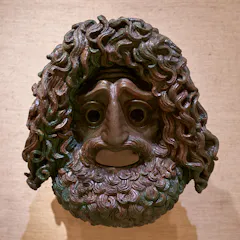
Post-colonial writing has expanded the concept of tragedy beyond Western thought.

There is nothing funny about the prospect of environmental collapse. But comedy can highlight the errors that led us to the crisis, and encourage us to act in the face of hopelessness.

Can artificial intelligence accurately simulate people’s religious tendencies in the face of disaster and tragedy?

Greek tragedies shed light into human nature’s darker corners. They can also illuminate the character of former FBI chief James Comey, whose unbending adherence to principles evokes ancient themes.

Tragedy is a peculiar thing. More than a style, different from genre, it cuts across art forms to carve out its own non-Euclidean aesthetic space. In the 4th century BCE Aristotle, in his Poetics, famously…
Top contributors
-

Professor of Creative Arts, Griffith University
-
Professor of Philosophy, Theology, and Ethics, Boston University
-
Associate Professor, China Studies Centre, University of Sydney
-
Professeure adjointe en criminologie, travaillant sur l'adversité et la résilience chez les enfants et les adolescents, Université Laval
-
Research Associate, Project on Managing the Atom, Harvard Kennedy School
-
Counseling Psychologist, Catholic University of Eastern Africa
-
PhD candidate, Classical Languages and Literature, University of Oxford
-
Professor of Classics, University of Florida
-
Marie Sklodowska-Curie Fellow, Department of Philosophy, University of Essex
-
Department Chair, Department of English, Stanford University
-
Senior Lecturer in Digital Media Production, University of Westminster
-
Professor, Department of Geography, Simon Fraser University
-
Professor, Health Sciences, Simon Fraser University
-
Associate Dean International, Faculty of Arts, Design & Humanities, De Montfort University
-
Teaching Professor, Eliot-Pearson Department of Child Study and Human Development, Tufts University