
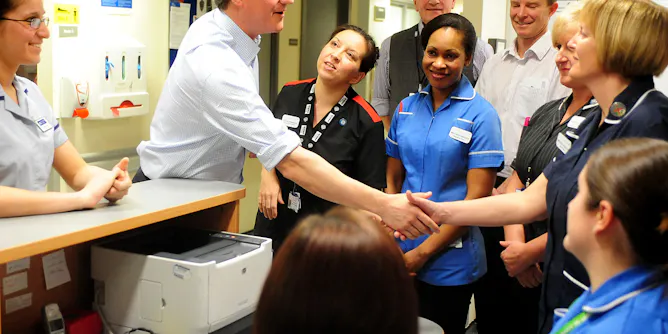
The government’s decision to reject the recommended 1% rise in NHS salaries has been met with “contempt” by the unions. The issue of public sector pay has become highly contentious, with each side arguing…
Articles on Statistics
Displaying 261 - 280 of 289 articles
The media are always fascinated by medical “breakthrough” stories: tales of hope that scientists have found cures for our most threatening diseases and tales of woe that our lifestyles are doing us harm…

The world’s second-largest economy has become the second-most watched and yet investors, politicians and economists are never quite clear what it is they’re looking at. China’s premier, Li Keqiang, is…

So the International Monetary Fund has revised its economic growth forecast for the UK upwards. It now expects 2.4% growth in the UK this year, up from the 1.9% they predicted a few months back. Cue celebratory…

The crucial thing about “big data” is the data. “Big” is relative, and while size often matters, real disruption can come from data of any size. This is not a new idea, being several hundred years old…

Yesterday’s article by Geoff Cumming, based on a very recent Proceedings of the National Academy of Science paper, argued that “null hypothesis significance tests” (NHST) are flawed – and he is correct…

For researchers there’s a lot that turns on the p value, the number used to determine whether a result is statistically significant. The current consensus is that if p is less than .05, a study has reached…
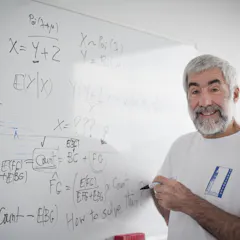
The Prime Minister’s Prizes for Science recognise excellence in science and science teaching. This year, we asked three prizewinners to reflect on their work and factors that influenced their careers…

Australian mathematician and statistician Terry Speed has been awarded the 2013 Prime Minister’s Prize for Science for giving biologists the statistical tools needed to fight cancer, and for a lifetime…

When people talk about ‘big data’, there is an oft-quoted example: a proposed public health tool called Google Flu Trends. It has become something of a pin-up for the big data movement, but it might not…

It’s autumn, and a new batch of students are starting university. Some are walking through the ancient gates of an Oxbridge college. Others are joining a redbrick university like Manchester or Bristol…

Smoking, drinking and hanging around street corners is a common characterisation of a bored, unhealthy, unemployed youth. Life is getting worse for young people, we’re often led to believe, but what do…

People are wildly wrong when we ask them about many aspects of life in Britain, as shown in a new survey by Ipsos MORI for the Royal Statistical Society and King’s College London. We think one in four…

The coalition government tells a story of “broken Britain”. Welfare spending is out of control. It is unaffordable. It is excessively generous. It undermines incentives because people are better off not…
A study found that politicians who used statistics were viewed as less trustworthy to the UK public. People reported they…

We assess risk every day. But very few of us receive any formal training in the requisite mathematics and statistics, and, partly as a result, poor decisions are made, both by individuals and governmental…

The Australian Open is upon us for another year, and the best tennis players in the world have assembled in Melbourne to compete for the right to call themselves “champion”. Much of the focus will be on…

An ambitious new project is attempting to replicate every single study published in 2008 in three leading academic psychology journals. It’s called the Reproducibility Project. As the name suggests, the…

Australians are drinking and smoking less but putting on weight like never before, a national survey by the Australian Bureau of Statistics has found. Results from the ABS Australian Health Survey, the…
With the AFL finals starting tonight, Swinburne University statistics professor Stephen Clarke has predicted which teams…
Top contributors
-

Senior Lecturer in Statistics, University of Glasgow
-
Professor of the Practice of Data Science, Washington University in St. Louis
-
Professor of Biostatistics and Epidemiology, Adelaide University
-
Professor of Statistics, Queensland University of Technology
-
Professor of Economics and Public Policy, ANU College of Arts and Social Sciences, Australian National University
-
Vice Provost for Faculty Affairs and Professor of Statistics, Virginia Tech
-
Associate Professor, Department of Statistics and Actuarial Science, University of Waterloo
-
Associate Professor of Mathematical Sciences, University of Technology Sydney
-
Professor of Business and Sports Analytics, University of Leeds
-
Professor of Statistics, Queensland University of Technology
-
Professor of Bioinformatics, WEHI (Walter and Eliza Hall Institute of Medical Research)
-
Emeritus Professor, La Trobe University
-
Professor, Future Fellow and Head of Statistics at UNSW, and a Deputy Director of the Australian Centre of Excellence in Mathematical and Statistical Frontiers (ACEMS), UNSW
-
Biostatistician, The University of Melbourne
-
Associate Professor, POLIS@ANU Centre for Social Policy Research, Australian National University