
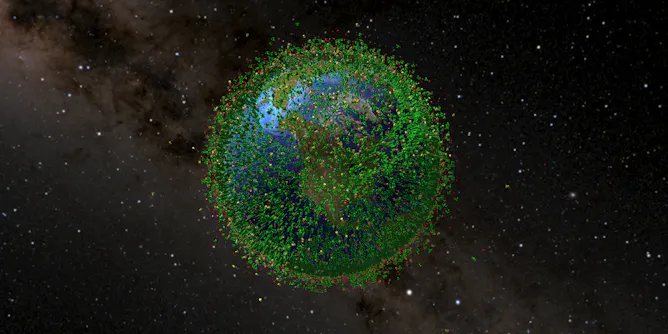
Unlike aircraft or cars, we can’t easily take satellites to a repair workshop.
Articles on Starlink
Displaying 1 - 20 of 29 articles

From space hotels and artificial meteor showers, to a new giant mirror that reflects sunlight to Earth — low-Earth orbit is getting weird.
How prepared are we for a solar storm, bad software update or cybersecurity event that could trigger widespread loss of satellite control?

If SpaceX launches one million new satellites, it will increase atmospheric pollution and risk of falling debris. And we will see more satellites than stars.
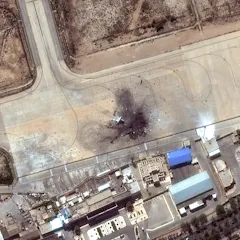
A new treaty on military space operations is highly unlikely, leaving private companies and militaries to define the boundaries of acceptable conduct in war.
The satellites the world relies on for navigation, communication and more get their bearings from distant black holes – but radio noise is blurring the picture.

Honeyed words seem to appease the US president, but it’s dangerous if he ends up thinking he can do anything he wants.
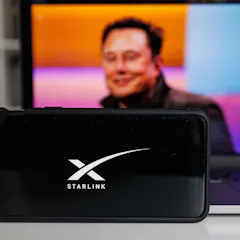
Musk’s ability to switch satellite communications on and off can make a considerable difference to sensitive situations.

Africa’s new space agency has an important role to play in coordinating satellite data and boosting connectivity.

The popular satellite internet service is helpful for education and disaster relief in remote island communities.

An overhaul of the mobile network could help us send texts and make calls in even the remotest areas. But there are technical challenges we’d need to overcome.

This year should see the first working prototype of a data centre designed for space.

The outcome of the election could have important implications for the world’s richest man.
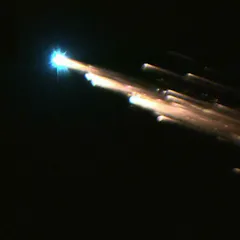
Burnt-up satellites could dump hundreds of tonnes of aluminium in the stratosphere every year. An atmospheric chemist explains what that might mean
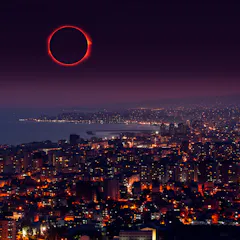
The sky is becoming more cluttered with satellites and space junk. This is affecting astronomical study, but will only have a minor effect — if any — on the viewing of the solar eclipse.

Megaconstellations of satellites are hindering the most powerful tool for space exploration: telescopes.
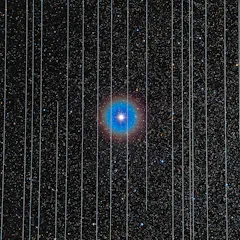
Starlink satellites emit bright, unintended and unexpected signals that can be detected by radio telescopes.
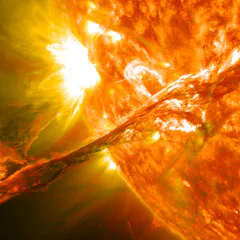
We’re currently a few years into the 25th studied solar cycle. An 11-year period of sun activity, this solar cycle is more active than previously expected.
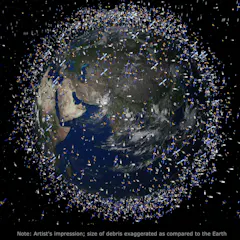
How might the space industry reduce its ecological footprint and better manage the debris it leaves in its wake?
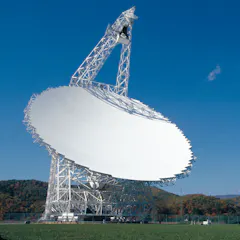
Many telescopes use the radio spectrum to learn about the cosmos. Just as human development leads to more light pollution, increasing numbers of satellites are leading to more radio interference.
Top contributors
-

Associate Professor, Astronomy, University of Regina
-
Professor, Physics and Astronomy, University of British Columbia
-
Associate Professor, Physical and Environmental Sciences, University of Toronto
-
Chercheur post-doctorant en stratégie, innovation et entrepreneuriat, Chaire Sirius, TBS Education
-
Astronomer, Australian National University
-
Professor, Adelaide University
-
Assistant Professor of Computer Science, University at Albany, State University of New York
-
Professor and Associate Dean (Environment and Sustainability in Faculty of Science), The University of Melbourne
-
Associate Professor of Space Systems, West Virginia University
-
Professor of Physics, UMass Lowell
-
Emeritus Professor of International Law, Western Sydney University
-
PhD candidate, School of History and Philosophy of Science, University of Sydney
-
Postdoctoral Fellow in Space Physics, University of Saskatchewan
-
Professor and Head of Computing Science, Australian Catholic University
-
Associate Professor of Electrical Engineering, United States Naval Academy