
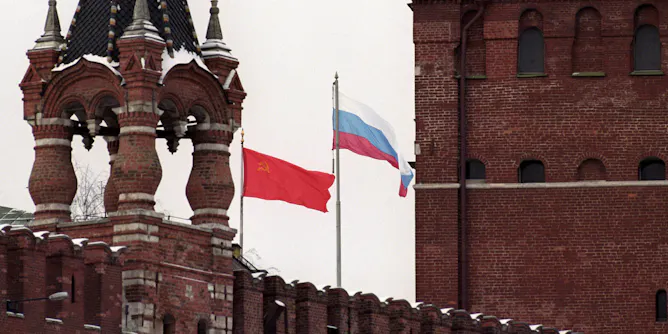
Former BBC reporter James Rodgers reflects on the end of the Soviet Union and finds lessons for today.
Articles on Soviet Union (USSR)
Displaying 181 - 200 of 319 articles

Activities in space today are far more numerous and complicated compared to 1967, before humans had landed on the moon or Elon Musk had been born. Two experts explain the need for better laws to keep space peaceful.
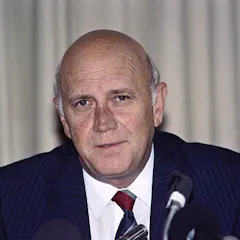
FW de Klerk as National Party conservative was paradoxically the right leader at the right time to relinquish white minority rule.
What does communism 2.0 mean for democracy?

War rugs are more reflections of market forces than memorials to suffering.
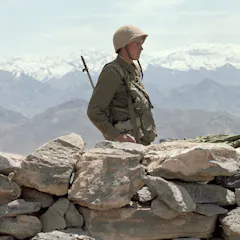
In the aftermath of the U.S. withdrawal from Afghanistan, Russia looks like an increasingly desirable international partner across much of the globe.
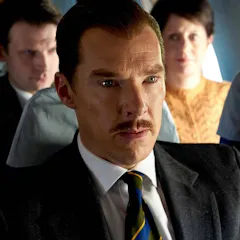
American intelligence has recognised there are four reasons why a ‘normal’ person might be convinced to spy.
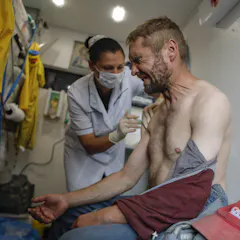
Coverage of Russian vaccination rollout has focused largely on concerns about ethics of development and inconsistent messaging. But Russian-language research complicates this picture.

Kennan was one of America’s few true experts on Soviet affairs. He famously urged a “Containment” strategy to prevent Soviet expansionism, advising against military responses and arms build-ups.
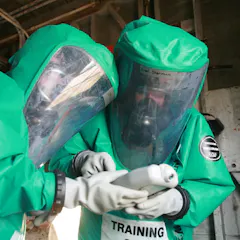
The sketchy history of international efforts to control bioweapons suggests that nations will resist cooperative monitoring of gene hacking for medical research.
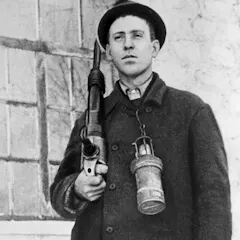
The audio version of an in-depth article about a record-breaking Soviet miner from 1935 who embodied a system of values that is central to contemporary work cultures today.
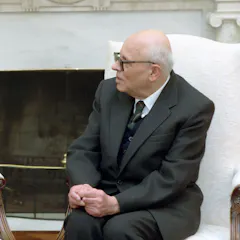
Andrei Sakharov was one of the most brilliant scientists of the nuclear age. But he is best remembered today as one of the most fearless defenders of human rights around the world.

Just as Fidel Castro’s 2016 death did not transform US-Cuba ties, his brother Raul’s exit from politics is unlikely to do so. But Cuba itself is changing. Eventually, Havana and Washington will, too.
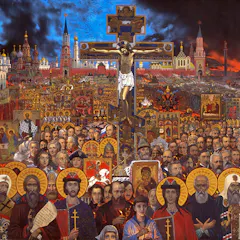
Cosmism, a theory that blends faith in science with religious traditionalism, serves as a source of inspiration for conservative Russian ideologues in search of a national idea.
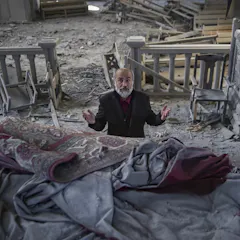
A peace deal brokered by Russia ended the war on Nov. 9, but the rich architectural heritage of the region is still at risk.

High-power microwave weapons are useful for disabling electronics. A new report says they ‘plausibly explain’ some ailments suffered by US diplomats and CIA agents in Cuba, China and other countries.
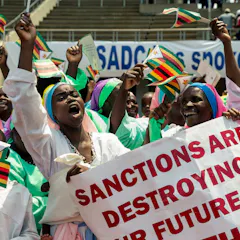
Countries or international organizations regularly enact sanctions against individual states. But how can the effectiveness of these measures be evaluated?
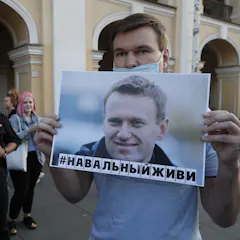
Vladimir Putin is a standard-bearer, rather than a pioneer in the history of Soviet and Russian political assassination.
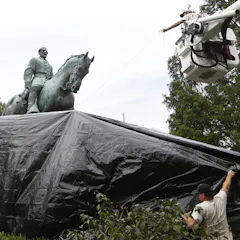
Once stripped of their symbolic power, problem monuments offer what educators call ‘teachable moments,’ helping people assess society’s current values and compare them with what mattered in the past.

Many people who participate in disinformation campaigns are unwitting accomplices and much of the information they spread is accurate, which makes it all the harder to identify the campaigns.
Top contributors
-

Professor of History and Political Science, University of Michigan
-
Professor of Military History, University of Calgary
-
Professor, Russian and East European History, University of Alberta
-
Associate Professor of Instruction in the School of Interdisciplinary Global Studies, University of South Florida
-
Shelby Cullom Davis Professor of International Security and Director of the Center for Strategic Studies, The Fletcher School, Tufts University
-
Reader in International Journalism, City St George's, University of London
-
Professor of International Security, University of Birmingham
-
Quondam Fellow of All Souls College, University of Oxford
-
Senior researcher, Centre for Social Change, University of Johannesburg
-
Professor of History at the Institute of Humanities and Social Sciences, Australian Catholic University
-
Political Scientist, University of the Western Cape
-
Founding Dean and Professor of International Studies, Hamilton Lugar School, Indiana University
-
Professor of Anthropology, Area Studies and Russian, United States Naval Academy
-
Lecturer, Department of Social and Political Sciences, Philosophy, and Anthropology, University of Exeter
-
Emeritus Distinguished Professor of Defense Analysis, Naval Postgraduate School