

Calculating your risk of death or hospitalization if you are infected with the coronavirus requires good data – notably, the total number of infections in the US. Unfortunately, that data is fuzzy.
Articles on Relative risk
Displaying all articles
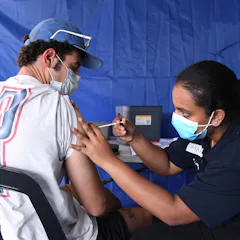
Unvaccinated people are ten times more likely to contract COVID, and more likely to pass it on than vaccinated people.

Clinical trials are used to establish that medicines work. But these don’t take into account the genetic differences between us that can mean very different outcomes for different patients.

Shrewd media consumers think about these three statistical pitfalls that can be the difference between a world-changing announcement and misleading hype.

Often there is tendency to overreact to risk estimates, so it’s worth unpacking what these really mean.

Relative risk is the risk one group of people has of developing a cancer compared to the risk of another group.

There are several ways scientists can explain risks of cancer and other diseases; some are easier to understand than others.
Top contributors
-

Adjunct Professor, School of Psychology, Curtin University and College of Health and Medicine, Australian National University
-
Adjunct Professsor, School of Psychology, Faculty of Health and Medical Sciences, Adelaide University
-
Professor at University of Melbourne and Research Fellow, Cancer Council Victoria
-
Professor of the Practice of Data Science, Washington University in St. Louis
-
Associate Professor, Epidemiology, Deakin University
-
CEO of the Centre of Excellence for Biosecurity Risk Analysis, The University of Melbourne
-
Subject Leader in Pharmacy, University of Huddersfield
-
Research Fellow in Statistics for Biosecurity Risk, The University of Melbourne
-
Adjunct Professor of Epidemiology, University of Colorado Anschutz