
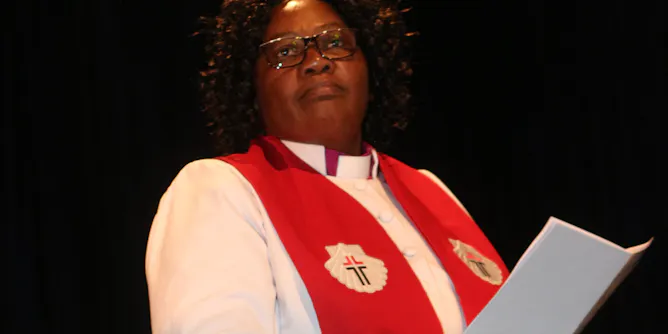
Bishop Purity Malinga is the first woman to be appointed Presiding Bishop in the Methodist Church of Southern African in over 200 years.
Articles on Patriachy
Displaying 21 - 40 of 40 articles

The South African child support grant is progressive in its gender-neutrality, yet men make up only 2% of those who collect it.
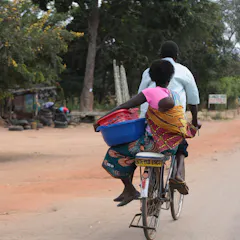
While not all men are willing to become involved in women and children’s health, some situations force them take on ‘women’s work’.

Close to 4 million teenage girls are subjected to breast ironing worldwide. This harmful cultural practice, which is most prevalent in West and Central Africa, needs to stop.

The French writer’s work and life make perfect cinematic subjects.
Rwandan girls with disabilities are challenging domination and stereotypes in a male-dominated setting.

Activists often face intransigent regimes and ruthless warlords. But women can use traditional insights into femininity and motherhood for political mobilisation and resistance.

The twilight of Jacob Zuma’s ruinous presidency coincides with growing revulsion at his misrule of South Africa. But, it’s important that his erstwhile supporters acknowledge their complicity.
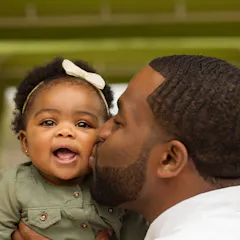
About 60% of children in South Africa under 10 years don’t live with their biological fathers. But research sheds light on those who despite the pressures remain involved in their children’s lives.

Why is it all about mom? Fathers want to be more involved in their children’s lives, but are limited by public policy and social institutions. This is a bad deal for dads, kids and moms alike.
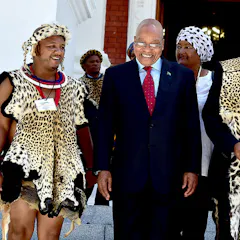
The clash over South Africa’s Traditional Courts Bill is essentially about custom and constitutionalism. The government is often seen as pandering to traditional leaders’ whims.

Chinese parents and the state are concerned about the declining marriage rate in the country. But the focus on single men ignores the root of the problem.
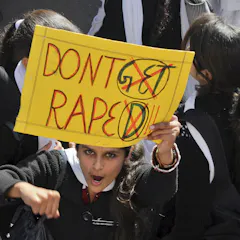
University campuses are prime locations for rape culture. What can be done about this reality?
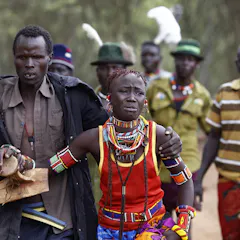
Education can be a powerful tool to stop the practice of child marriage. It empowers girls, and their success can ultimately boost their communities.

The world is generally not safe for women. But some projects in North Africa provide a glimpse of hope as the world marks the UN’s International Day for the Elimination of Violence against Women.
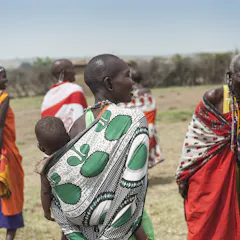
African women have had to explain themselves to a world that does not seem to understand them.
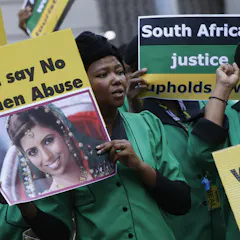
South Africa’s violence against women ranks as one of the worst in the world. As much as 40-50% of women in the country have suffered intimate partner violence.
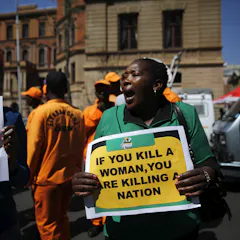
South Africa is emblematic of why violence against women responses in Africa are failing. While good measures are being rolled out, it lacks a united, comprehensive, multi-disciplinary response.
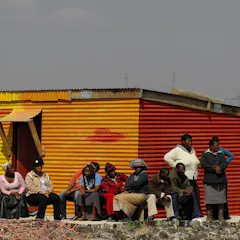
Writing about the women’s and feminist movements is a definitional minefield. The two are often conflated, more so in Africa.
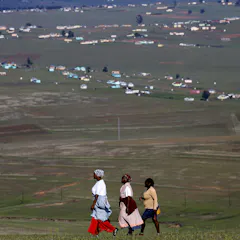
The Traditional Courts Bill ignores concerns that women do not get a fair hearing. The courts tend to rule in line with patriarchal values; violating the constitution, which guarantees equality.
Top contributors
-

Researcher, Unit for Religion and Development Research, Faculty of Theology, Stellenbosch University
-
Professor in Food Security; Head of the Department of Agricultural Economics, Extension and Rural Development, University of Pretoria
-
Network and Research Manager: ARUA – UKRI GCRF FSNet Africa, University of Pretoria
-
Professor, Department of Legal Studies, School of Public Policy, University of Massachusetts Amherst
-
Professor of Political Science and Chair of the South African Research Initiative in Gender Politics, Stellenbosch University
-
Researcher, Centro Brasileiro de Análise e Planejamento (CEBRAP); University of Johannesburg
-
Ph.D. Candidate, Political Science, University of Cincinnati
-
Lecturer in Environmental Sustainability, University of Energy and Natural Resources
-
PhD Researcher in Environmental Peacebuilding, King's College London
-
PhD Candidate in Political Science, University of Cincinnati
-
Assistant Professor of Psychology, NYU Shanghai
-
Lecturer in Politics and International Relations, University of Leicester
-
Associate Professor of Literature and Director, African Women's Studies Centre, University of Nairobi
-
Professor of African legal pluralism, University of the Western Cape
-
Professor of French, University of Leeds