
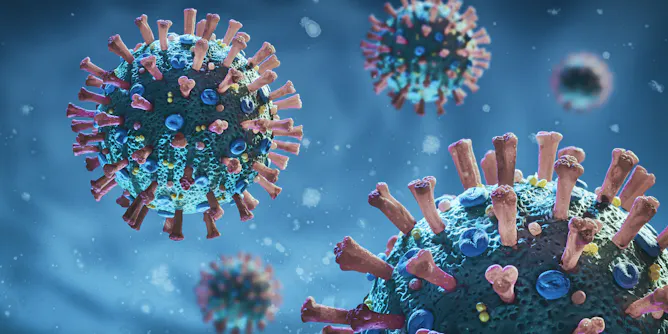
The current COVID-19 vaccine does not match the strain that’s now becoming dominant in the US, which could lead to a rise in COVID-19 cases.
Articles on New Covid variants
Displaying all articles

As we prepare for the festive season, it’s easy to let COVID boosters fall off our to-do lists. But COVID is still circulating and new shots are available.
LP.8.1, a descendant of Omicron, is driving a growing proportion of COVID infections in Australia and elsewhere.
XEC is a recombinant variant, meaning it’s a hybrid of two previously existing variants. Genomic data suggests it’s making up around 5% of cases in Australia – but it may grow.
Emerging evidence suggests LB.1 could be more transmissible than earlier Omicron subvariants, but there’s nothing to suggest it will cause more severe disease.
‘FLuQE’ is a direct descendant of the earlier ‘FLiRT’ variants. But an additional mutation could make it more of a worry.
The JN.1 variant has become dominant in Australia and around the world, causing large waves of infections. Here’s what we know about it so far – and why it’s so important.
Two new omicron variants seem to be waiting in the wings to usurp BA.5. Here’s what we know about BQ.1 and XBB.
BA.4.6 seems to be even better at evading our immune response than BA.5.

Animal reservoirs and people who experience chronic COVID infections could potentially see the emergence of new variants. But these variants aren’t necessarily cause for concern.

A combination of seasonal factors, under-diagnosis and under-reporting could explain why rates of COVID hospitalisation and death are rising faster than cases.

Authorities and experts are reducing the time window they estimate people are protected from getting infected again after they’ve recovered from a bout of COVID.

With the relaxation of mask-wearing mandates, there’s even more need to know how much over-the-counter tests help.
Top contributors
-

Professor of Biostatistics and Epidemiology, Adelaide University
-
Associate Professor of Molecular Medicine, UMass Chan Medical School
-
Scientific Officer in Biomedical Sciences, University of Leeds
-
Associate Professor, Immunovirology and Pathogenesis Program, Kirby Institute, UNSW
-
Associate Professor and Chief Health Officer - COVID and Health Emergencies, Burnet Institute
-
Clinical associate professor, Australian National University
-
Director and CEO, Burnet Institute
-
Senior Research and Policy Officer, Burnet Institute
-
Assistant Professor of Medicine, UMass Chan Medical School
-
Professor, School of Biomedical Sciences and Pharmacy, University of Newcastle
-
Virology Research and Teaching Fellow, School of Molecular and Cellular Biology, University of Leeds
-
Associate Professor and Research Leader in Virology and Infectious Disease, Griffith University
-
Senior Lecturer in Microbiology, Western Sydney University
-
Senior Lecturer, Medical Microbiology, University of Westminster
-
Associate Professor of Medicine, University of Virginia