
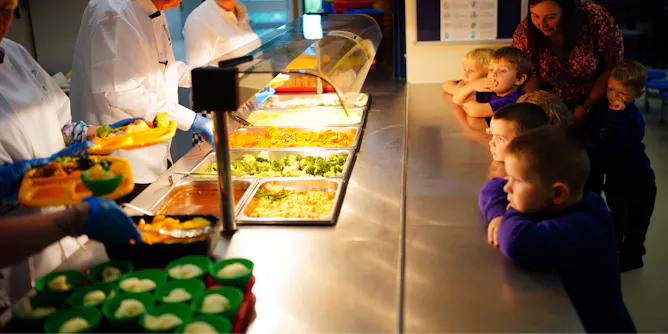
Australia can learn from other countries to introduce a universal free school lunch program that benefits children, families, local farmers and the planet.
Articles on National School Lunch Program
Displaying all articles
Free food may fill your stomach, but it doesn’t always satisfy the desire to feel fully human.

There are few, if any, alternative sources of food insecurity data that don’t rely on the survey the government is ending.
Since nutrition standards were strengthened in 2010, eating at school provides many students with healthier food than is available cheaply elsewhere. Plus, reducing stigma increases the number of kids getting fed.
An expert on food policy explains how the end of COVID-19 waivers will impact children’s access to food, as well as the importance of food banks and pantries.
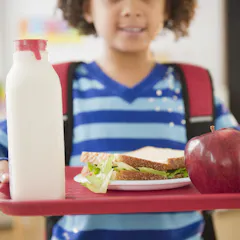
A food policy expert explains how school lunches changed during the COVID-19 pandemic and what’s wrong with going back to the normal system now.
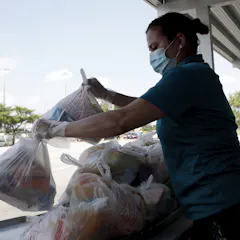
It helped that school food service staff quickly changed their preparation, packaging and distribution methods to feed students who were no longer eating in cafeterias.

US cities and states are responsible for the vast majority of K-12 funding.
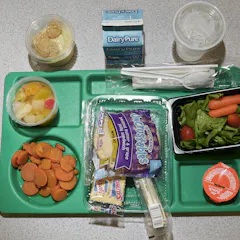
The millions of US children whose parents can’t always afford enough nutritious food for their families get about a quarter of their calories from what they eat at school.
So far, children have not been as sickened by the coronavirus as adults. So why do officials talk about closing schools? And what does this mean for you as a parent? A public health expert explains.

Backpack programs that give students easily prepared foods, like boxed macaroni and cheese and canned beans, can make a difference.
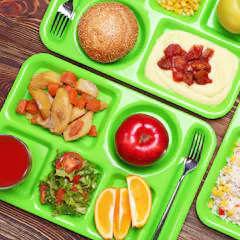
There would be many benefits from a national school food program, including a chance to teach children healthy eating habits that could last a lifetime. Why can’t it happen?

Research shows that children attending schools with low-quality food environments, in poorer neighborhoods, gain more central body fat – putting them at risk of obesity and cardiometabolic disease.

As Canadian kids head back to school this week, many will be hungry. Lacking fruits, vegetables and other nutritious foods, they will suffer mood problems, disease and low academic performance.

Students with unpaid meal debts have been experiencing some shaming policies at school. New rules are aimed at protecting these children, but the real solution may lie in free meals for all.

Ravenous students, busy parents, nutrition professionals and school officials all have their own ideas about what belongs on the school lunch table. Plenty of criticism centers on the unhealthiness of…
Top contributors
-

Professor of Human Development and Family Sciences, University of Connecticut
-
Assistant Professor, Education Studies, College of Education, University of Oregon
-
Professor of Health Promotion, Dalhousie University
-
Professor of Public Health, University of Michigan
-
Professor, Educational Policy and Organizational Leadership, University of North Carolina at Chapel Hill
-
Associate Professor of Health Systems and Population Health, Epidemiology, University of Washington
-
Assistant Professor of Education Finance and Policy, University of Washington
-
Associate Professor in Food Systems, The University of Melbourne
-
Postdoctoral Research Fellow, University of Washington
-
Associate Professor of Political Science, University of Richmond
-
Assistant Professor of Sociology, Ithaca College
-
Assistant Professor of Health Sciences, Ursinus College
-
PhD Candidate in Behavioral & Community Nutrition, Virginia Tech
-
Assistant Professor of Pediatrics, University of Pennsylvania
-
Canada Research Chair in Digital Media Use by Children and Its Implications for Promoting Togetherness: An Ecosystemic Approach, Université de Sherbrooke