
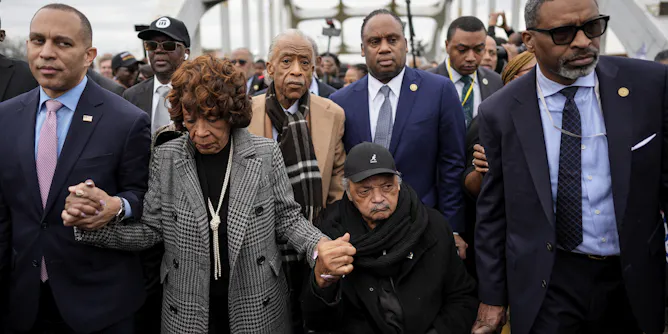
A civil rights activist who ran for president twice and became a Democratic power broker, Jackson was an American political icon. But above all, he was a Southerner.
Articles on Michael Dukakis
Displaying all articles

Jesse Jackson proved in the 1980s that white working-class voters will support racialized candidates if their message is right. This could bode well for Kamala Harris.
From geographic balancing to making up for what the presidential candidate lacks, the considerations for picking a vice presidential candidate have changed and evolved since the 19th century.

Featuring several unique rules, including no live audience and mics that cut off when it’s not a speaker’s turn, the debate might help shape the 2024 presidential race.
For much of the country’s history, the Republican Party was the party of Lincoln and racial equality, and the Democratic Party backed Jim Crow laws and white supremacy. The two parties switched.

President Trump’s law-and-order campaign rhetoric has been compared to Richard Nixon’s and George Wallace’s similar themes in 1968. But such appeals go much further back, to the US in the early 1800s.
Top contributors
-

James S. Sherman Professor of Government, Hamilton College
-
William Nelson Cromwell Professor of Jurisprudence and Political Science, Amherst College
-
Senior Lecturer in Communication, Auburn University
-
Professor of Journalism, Indiana University
-
Professor of History, Centre for Oral History and Digital Storytelling (COHDS), Concordia University
-
Professor of Political Science & Public Affairs, Western Carolina University
-
Professor of Political Science, Coastal Carolina University