

Characteristics that would come to define Mau Mau camps – neglect, forced labour and ill-health – were ingrained long before 1952.
Articles on Mau Mau
Displaying all articles

If archives were destroyed and public history suppressed, where else might the past be found?
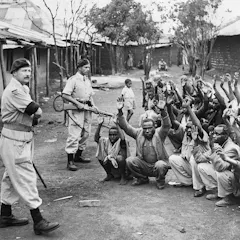
The Christian Council of Kenya got involved in a violent colonial effort to rehabilitate independence fighters. It saw this as an opportunity to evangelise.

On 24 April 1950, 29 members of Dini ya Msambwa, an anti-colonial religion, were killed by British forces. The UK government refuses to acknowledge this massacre.

The land question and reparative packages for the ex-Mau Mau remain unaddressed.
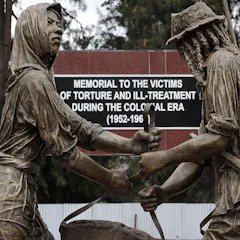
Oral histories serve as a challenge to the evidence in the colonial archive.

Operation Legacy highlights the repercussions faced when people with power determine what information is available to interpret events of the past.

The politics of ethnicity laid the groundwork for Mungiki.
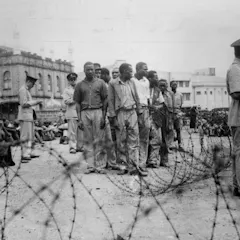
Thousands of Kenyans were held in detention camps, and the British imperialist government tried to cover up brutal violations that occurred there.

The visit will acknowledge the more painful aspects of the UK and Kenya’s colonial history.

You can count on Mama Ngina Kenyattta to defend the family name, in good times and bad.

Music has often been used as a political tool to urge Kenyans to forget the sins of colonial and post-colonial regimes.

Spain has made it a punishable offence to praise the regime of General Franco.

Far from the myth of the omnipotent father of the nation, big man or dictator, the Kenyan presidential system was built on divisions and uncertainty.
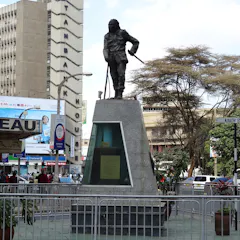
The resilient Mau Mau freedom fighters failed to maintain revolutionary action after independence.
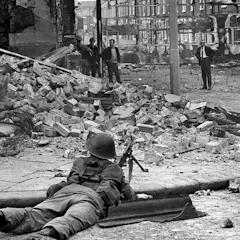
Some journalists have claimed that ‘thousands’ of documents which have gone missing at the National Archives are proof of ‘history theft’. It’s probably just old-fashioned incompetence.
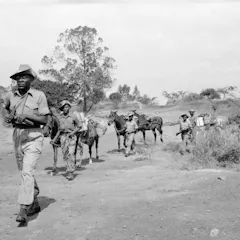
A myth is doing serious injustice to the way historians have approached decolonisation.

As with most aspects of criminal justice in sub-Saharan Africa, the death penalty as it currently exists in law is a colonial import. Criminal justice before the modern era was a private matter.
Top contributors
-

Elise Richter Fellow, Senior Postdoctoral Researcher, Universität Wien
-
Lecturer in International History, Loughborough University
-
Director of History & Policy at the Institute of Historical Research and Professor of British and Commonwealth History, School of Advanced Study, University of London
-
Visiting Fellow in History, Anglia Ruskin University
-
Research associate, University of Bristol
-
Lecturer of Music, Kabarak University
-
Adam Smith Fellow, Mercatus Center, George Mason University
-
Associate Professor, History, Carleton University
-
Senior Lecturer, University of Essex
-
Associate Professor Emerita, Roskilde University
-
Lecturer in the History of Modern Africa, University of Bristol
-
Lecturer of History, University of Embu
-
Researcher, University of Warwick
-
Senior Research Associate in African Politics, Newcastle University
-
Term Assistant Professor, Department of Criminology Law and Society, George Mason University