
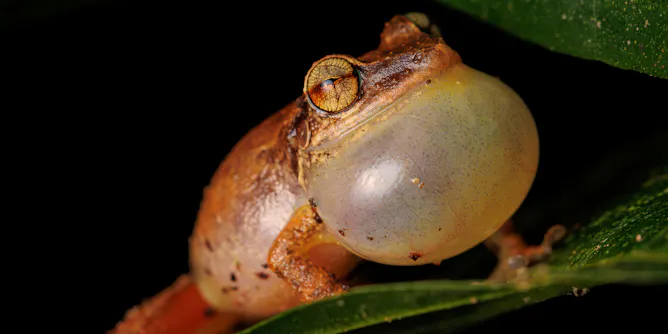
A new study tracks how young frogs are trying to avoid a deadly fungal infection.
Articles on Mathematical models
Displaying all articles
New research reveals our understanding of dust’s role in the environment is far from settled.

Measuring the ages of planets and stars is tricky. An observational astrophysicist describes the subtle clues that provide good estimates for how old different space objects are.

Using a mathematical model, researchers found that good hygiene can reduce the harmful effects of antibiotic use.

Recent research shows how the relationship between alcohol consumption, queuing and crowds can lead to violent behaviour in city centres at night.

The assumption that more detail is better is questioned by a new study.

A lottery jackpot being won by 433 people in the Phillipines has raised accusations of foul play. Then again – such outcomes usually do.

Here’s what we still need to find out before we can know when we’ll be able to return to our pre-coronavirus ways.

If supplies of COVID-19 vaccine are initially limited, who should be vaccinated first? A mathematical model shows when and why it’s best to start with the young, and when older people should go first.

Schools reopening during the current coronavirus pandemic need to calculate class sizes to prevent the spread of disease and minimize disruptions.
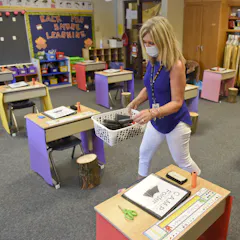
New research points to why reopening elementary schools is the safest bet and what else needs to happen for schools to have the best chance of staying open.

A vaccine that’s 70% effective might not be good enough if too few people are willing to be vaccinated, new research shows.

The science to policy process that was developed to guide climate mitigation decisions can be applied to the response to the COVID-19 pandemic, without having to be reinvented.

How and when the US economy reopens will look different state to state, and for good reasons. This Q&A explains why, and why some states are working together.

Cause for a degree of relief.

Testing everyone for COVID-19 isn’t realistic in a country the size of the US, but there are ways to design testing systems that can catch most of the cases.

Only time will tell.

Each model is another part of the jigsaw.
Top contributors
-

Professor & Director, Global Ecological Change & Sustainability Laboratory, University of Guelph
-
Professor of Applied Mathematics, University of Waterloo
-
Lecturer in Probability and Statistics and Senior Research Fellow in Infectious Disease Modelling, University of Oxford
-
Professor in Botany, Zoology and Ecology, Stellenbosch University
-
Professor of Public Health Research, Co-Director of Crime and Security Research Institute and Director of the Violence Research Group, Cardiff University
-
Associate Professor of Industrial and Operations Engineering, University of Michigan
-
Chair professor, Cardiff University
-
Senior Lecturer in Applied Mathematics, Cardiff University
-
Professor of Mathematical Biology and Public Engagement, University of Bath
-
Associate Professor in Social and Environmental Uncertainties, University of Birmingham
-
Associate Professor, Marine Biology, University of the Western Cape
-
Associate Professor of Mathematical Sciences, University of Technology Sydney
-
Professor and Chair, Division of Environmental Health Sciences, University of California, Berkeley
-
PhD Candidate, Applied Mathematics, University of Waterloo
-
Assistant Professor, Psychology, University of Waterloo