
Learning another language is not a miracle cure for aging, and it cannot guarantee protection against Alzheimer’s disease. But it does have various other benefits.
Articles on Language acquisition
Displaying all articles
Fairness may entail an obligation on government or society, as well as on migrants.

Describing artificial intelligence as having neural networks and understanding language has implications for how we understand both AI and the human brain.

Growing up with more than one language has obvious advantages for children.

We acquire languages in a intuitive process that involves little effort; we learn them through the conscious assimilation of grammatical rules and usage.
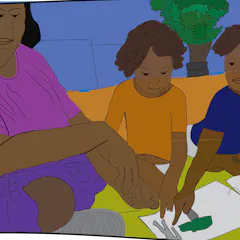
Previous studies of baby talk have focussed on European languages, Mandarin and Japanese. For the first time, research looks at an Australian Indigenous language.

Children may hear a lot of words when sitting in front of or interacting with screens, but to learn language children need to interact with physical objects.

COVID public health measures included school closures and a shift to online learning. This placed immigrant families at a disadvantage as they saw to their children’s emotional and educational needs.

Learning a language to speak adequately requires a minimum of around 870 hours. Some Australian states mandate around 1,000 hours through secondary school, but others require less than half that time.

Teaching deaf babies sign language improves the success of cochlear implants – and also safeguards their long-term physical and mental health.

In languages from Central Asia to the Amazon and New Guinea, stringing multiple ideas together is something children learn at an early age.
Top contributors
-

District School Administrator and PhD Student in Deaf Education, University of Tennessee
-
Doctoral Student, Curriculum Studies, University of Saskatchewan
-
Professor of Deaf Education, University of Tennessee
-
Senior Lecturer in Languages and TESOL
-
Research Fellow in Linguistics, Western Sydney University
-
Warlpiri Indigenous Knowledge Holder, Indigenous Knowledge
-
Researcher, Tangentyere Research Hub, Australian National University
-
Investigador Ramón y Cajal, Universidad de Sevilla
-
Associate Professor of linguistics, Australian National University
-
Warlpiri Indigenous Knowledge Holder, Indigenous Knowledge
-
Professor of Psychology, Western University
-
Senior Lecturer, School of Languages and Linguistics, The University of Melbourne
-
Postdoctoral Researcher of Language and Literacy, University of Tennessee
-
PhD Candidate, Brain & Cognitive Science, University of Calgary
-
Professor Emerita, Department of Teaching and Learning, Stockholm University