
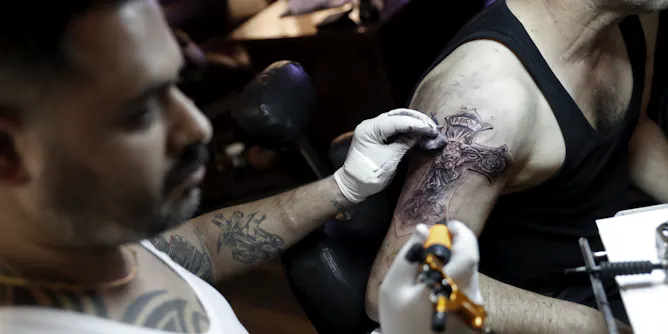
Historically, many Christians got tattoos around Holy Week − usually a cross − to honor Christ’s martyrdom.
Articles on James Cook
Displaying all articles
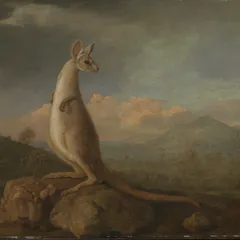
How did George Stubbs, one of England’s foremost painters of horses and dogs, get Australian animals so wrong?

Whistleblower allegations that the government possesses UFOs may not be backed up by public physical evidence, but some argue that listening for extraterrestrial life is the first phase of contact.
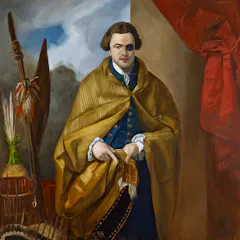
Daniel Boyd’s solo exhibition Treasure Island, now at the Art Gallery of New South Wales, is a deeply political and personal interrogation of Australia’s colonial history.

Hollywood movies have long leaned into colonial representations of the tropics: imagined as romantic palm-fringed coasts full of abundance, but also scary places full of pestilence and primitiveness.

Indigenous story-telling of Cook’s landing has transformed the way we understand his legacy in Australia. And the way he came ashore set some of the terms for future colonial-Indigenous relations.
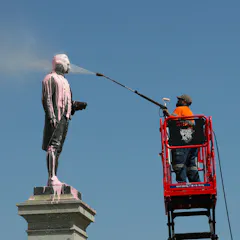
250 years since Captain Cook landed in Australia, it’s time to acknowledge the violence of first encounters
The Conversation, CC BY63 MB (download)
The way Australia has commemorated Cook's arrival has changed over time – from military displays in 1870 to waning interest in Cook in the 1950s, followed by the fever pitch celebrations of 1970.
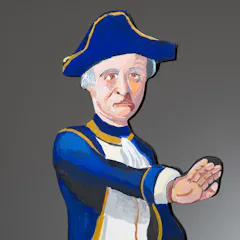
For too long, Cook was a promise recollected in pigment, bronze and stone. Contemporary First Nations artists are challenging this imagery.
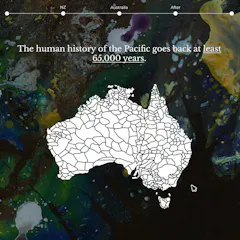
Explore Cook’s journey through the Pacific, the orders that brought him in search of the ‘Great Southern Land’ and the impact of his arrival in our new interactive.

Both islanders played a central role in Cook’s three voyages across the Pacific, but their contributions have largely been overshadowed in what is generally thought of as era of European exploration.
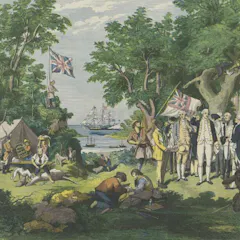
To find out how the teaching of Captain Cook in Australian schools has changed, I examined textbooks used in the 1950s until today.

On one of the world’s most remote islands, a species of duck has learned to scavenge on dead seals.
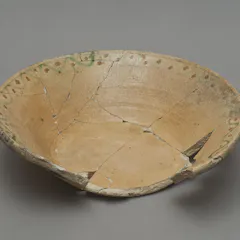
Though the Indigenous inhabitants were using white clay long before them, Sydney-made pottery helped colonists maintain different aspects of ‘civilised’ behaviour.
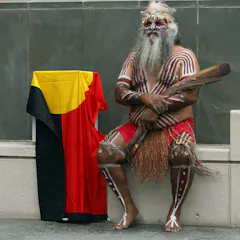
The question of repatriating objects is clearly more complex than returning human remains. It needs more debate, and more creative interventions to move beyond the current impasse.
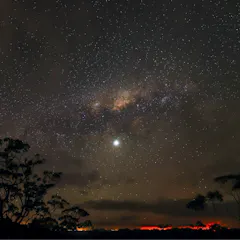
What did Isaac Newton, Captain Cook and Eddie Mabo all have in common? Each, in their own way, looked to the heavens to make sense of the world, and the importance of their place in it.

Debate over ‘discovery’ of Australia is alive and well – in the mind of one Sydney newspaper editor.
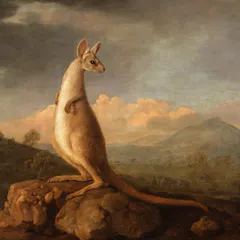
Not for the first time Britain and Australia are at loggerheads over cultural heritage. At issue this time are two images of genuine historical significance to both countries: Kongouro from New Holland…
Top contributors
-

Co-Director, Australian Centre for Indigenous History, Australian National University
-
Distinguished Teaching Fellow, Western Sydney University
-
Adjunct Professor, University of Technology Sydney
-
Assistant Director of the University Museum of Zoology, Cambridge, University of Cambridge
-
Sir John Monash Distinguished Professor, Monash University. Deputy Director ARC Centre of Excellence for Indigenous and Environmental Histories and Futures, Monash University
-
Ph.D. Candidate in Astronomy and Astrophysics, Penn State
-
PhD Candidate, Department of English, Concordia University
-
Adjunct Associate Professor, University of Technology Sydney
-
Associate Lecturer in Biodiversity Conservation and Ecology, UCL
-
Senior Lecturer, Critical and Theoretical Studies, Victorian College of the Arts, Faculty of Fine Arts and Music, The University of Melbourne
-
Postdoctoral Fellow, School of Humanities & Languages, UNSW
-
University Distinguished Professor of Astronomy, University of Arizona
-
Lecturer, Griffith Law School, Griffith University
-
Professor of Sociology, Boston College
-
Lecturer and Researcher in Plant Humanities, UNSW