
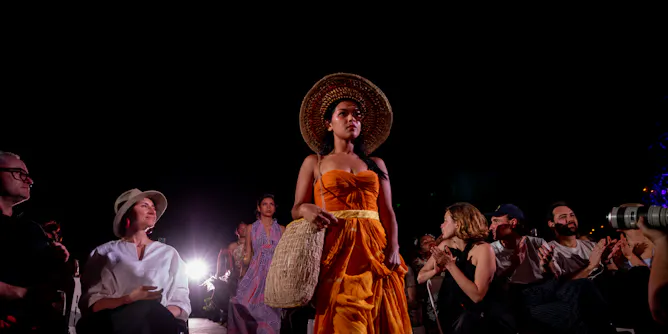
People in the First Nations fashion industry see their work contributing to cultural tradition, economics and cultural sustainability, and blak pride and storytelling.
Articles on Indigenous art
Displaying 21 - 40 of 136 articles

My top three works situated witnessing as a political act. These works invite you to revisit what you thought you knew.
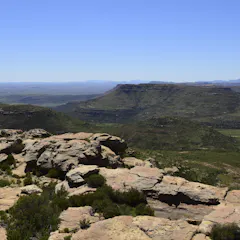
Some explorers believed they had found unicorns depicted on rocks. The truth behind the paintings is far more interesting.
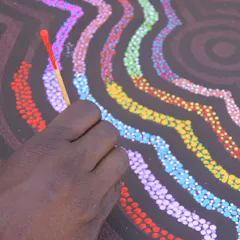
Remote art centres are central to the Indigenous contemporary art industry. They typically have a white art centre manager and other staff overseen by an Indigenous board.

There’s one simple rule when buying First Nations art or crafts: the more information the better.
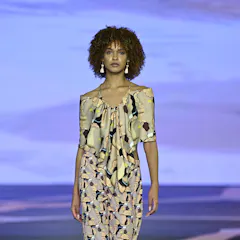
Wiradjuri woman Denni Francisco will be the first Indigenous designer to have a solo show at Australian Fashion Week.
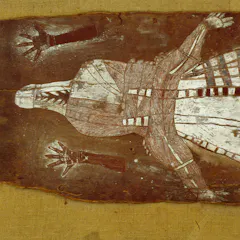
Majumbu’s work sits in the Melbourne Museum, but until now he has not been named as the artist.
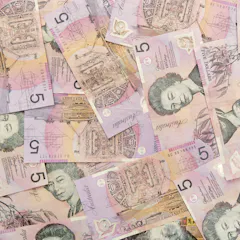
While breaking with one “tradition”, an Indigenous motif on Australia’s $5 banknote will restore another.
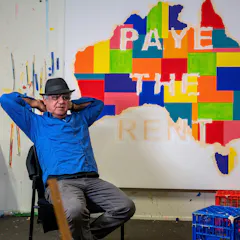
Bell is an internationally renowned artist who works across painting, installation, video and performance, and a new documentary brings him to cinemas.
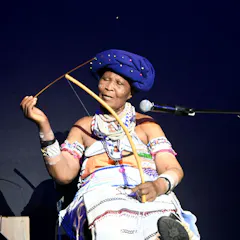
The queen of Xhosa music has passed away. She reinvigorated ancient Xhosa cultural traditions through performance and teaching.
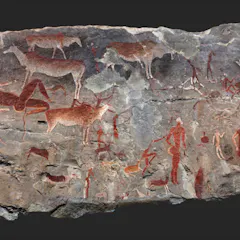
A new exhibition in Johannesburg focuses on the beliefs and paintings of the San people.
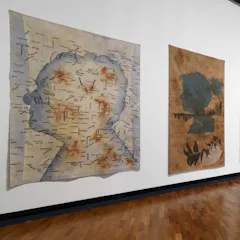
Waanyi woman Judy Watson and second-generation Anglo immigrant Helen Johnson both use archival materials to explore Australia’s violent history.
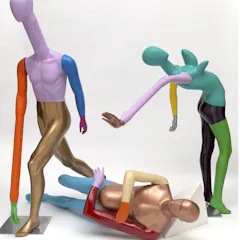
Embodied Knowledge: Queensland Contemporary Art is a celebration of women, people of colour and LGBTIQA+ artists.

Indigenous oral history is more than a methodology. It is living history, practised for thousands of millennia, intrinsically woven into Aboriginal people’s way of life and culture.
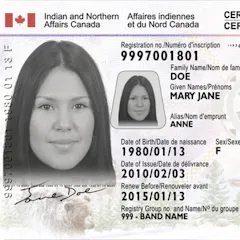
Challenging Indigenous identity fraud in academia must name and focus explicitly on structures of whiteness, white entitlement and settler colonialism so we don’t recreate the harms of past policies.
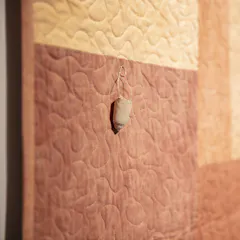
Descendants of the Bidjara, Ghungalu and Garingbal peoples, two renowned artists come together in this family exhibition.
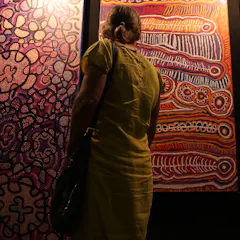
The Productivity Commission has proposed inauthentic Indigenous art should be labelled. But ‘fake art’ is only part of the problem.
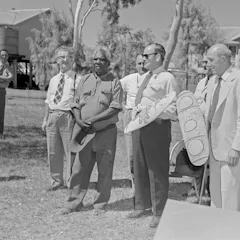
During the 1950s, Nat made hundreds of carvings. Today, many of these are likely to be lying unidentified in people’s homes and in museum basements.

The Spencer/Cahill Collection at Museums Victoria contains approximately 170 bark paintings – and now we can name one of the artists behind them.
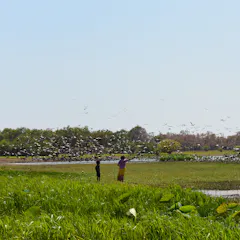
The Kakadu region has gone through immense transformation throughout history. How can archaeological food scraps tell us about how the First Australians adapted?
Top contributors
-
 Joanna Mendelssohn is a Friend of The Conversation.
Honorary Senior Fellow, School of Culture and Communication, The University of Melbourne
-
Chair in Rock Art Research and Director of the Place, Evolution and Rock Art Heritage Unit (PERAHU), Griffith University
-
Professorial Research Fellow, Adelaide University
-
Honorary Professor, Edith Cowan University
-
Honorary Senior Lecturer, Australian National University
-
Professor, College of Creative Arts, Design and Humanities, Adelaide University
-
Distinguished Professor of Design History, UTS, University of Technology Sydney
-
Chancellor’s Indigenous Research Fellow, Faculty of Design and Society, University of Technology Sydney
-
Adjunct professor, Adelaide University
-
Professor, Critical Indigenous Studies and Director of The Centre for Global Indigenous Futures, Macquarie University
-
Professor, Australian and Aboriginal History, Faculty of Arts, Design and Architecture, Convenor: Indigenous Land & Justice Research Group, UNSW
-
Adjunct Professor of Art History, Australian National University
-
Professor, Director of Centre for Rock Art Research + Management, The University of Western Australia
-
Senior Curator of Australian and First Nations Art, National Gallery of Victoria, The University of Melbourne
-
Professor, The University of Melbourne