
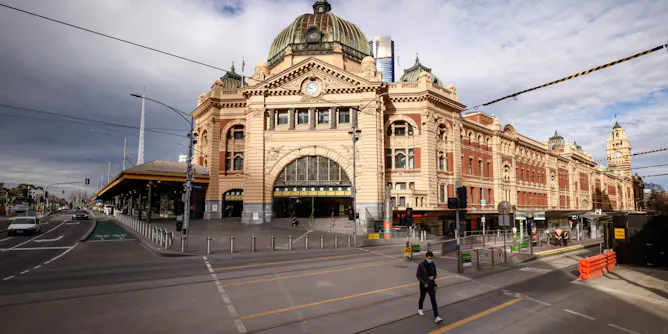
What did Melbourne and Victoria get right, and wrong, amid the pandemic?
Articles on Hotel Quarantine
Displaying 1 - 20 of 47 articles
Events have overtaken state plans for limited numbers of international students to return. With NSW dropping quarantine for fully vaccinated arrivals, flight capacity is the final obstacle.
There are reasons for concern, but there are also some protections in place.
Is a 7-day home quarantine enough? What are the risks? And how will we ensure people stay home? Epidemiologist Catherine Bennett answers your questions.
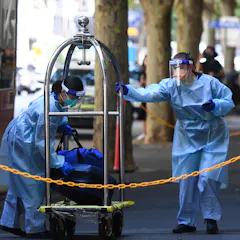
Victoria’s OHS regulator has fined the state’s health department for failing to keep hotel quarantine workers safe from COVID. This serves as a warning for all employers, ahead of the nation opening.

‘Contracting out’ government functions for delivery by the private sector has become the standard way of doing things across all levels of government in Australia.
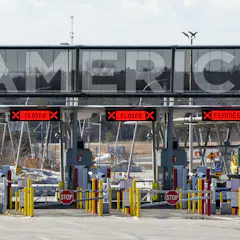
Pressure is mounting to reopen the Canada-U.S. border, but there are risks. How well those risks are managed may be the difference between pandemic recovery or a fourth wave of COVID-19.

We can do better than building a village of glorified dongas. Smart quarantine can be much higher-tech, and more adaptable for future uses once the pandemic is over.
People who contract COVID, and their contacts, have successfully self-isolated at home since the pandemic began.
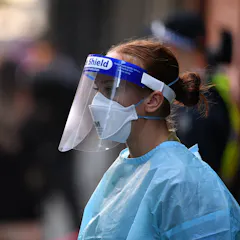
The government says hotel quarantine is ‘serving Australia very well’. But if you look at the leaks as a proportion of COVID-positive returnees, it’s a different story.

Will new guidelines on how to protect front-line workers acknowledge the coronavirus can spread via the air we breathe? It’s time they did.
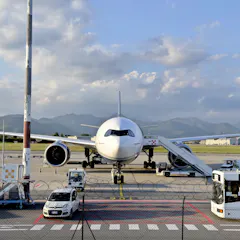
You only have to prevent one case, which could have otherwise led to community spread and lockdown, for such a scheme to pay for itself many times over.
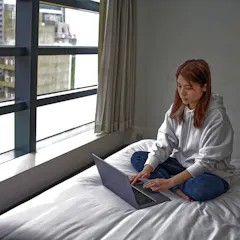
International students have been admirably persistent in studying online for more than a year. But as other countries open their doors, Australia risks losing them if it fails to show they are wanted.
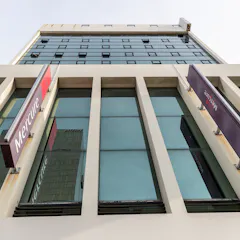
Airborne transmission is likely to be behind several recent leaks in hotel quarantine. But the Northern Territory has a quarantine model that works.
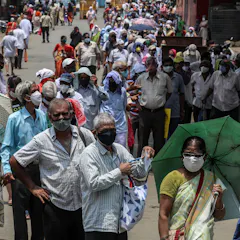
COVID-19 has created a temporary but desperate minority of Australians. These are the roughly 34,000 citizens overseas who say they are stranded.
Our current quarantine capacity would take six months to handle the return of 150,000 existing students, but 70,000 new students every six months would also be needed to halt the fall in enrolments.

Another city, another snap lockdown, and another round of asking whether it will successfully prevent disaster this time, or whether the coronavirus has already spread undetected through the community.

The amount of risk from overseas arrivals depends not just on Australia’s vaccination rates, but also on the particular circumstances of the country from which people are travelling.
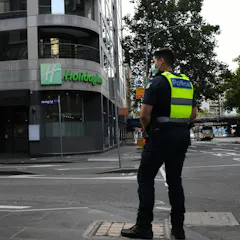
The revamped Victorian hotel quarantine system appears to have addressed the weaknesses of the previous system, particularly around the risk of airborne transmission.
Australia has a long history of incarceration of migrants, Indigenous people and those considered ‘enemies’ of the state. This has formed a ‘template’ for modern-day quarantine and detention policies.
Top contributors
-

Chair in Epidemiology, Deakin University
-
Associate Professor, Epidemiology, Deakin University
-
Associate Principal Research Fellow, Burnet Institute
-
Professorial Fellow, University of Canberra
-
Director, Centre for the Study of Higher Education, The University of Melbourne
-
Professor of Law, The University of Melbourne
-
Professor of Epidemiology, Population Interventions Unit, Centre for Epidemiology and Biostatistics, Melbourne School of Population and Global Health, The University of Melbourne
-
Professor of Biostatistics and Epidemiology, Adelaide University
-
Professor and Tier 1 Canada Research Chair in Global Health Governance; Scientific Co-Director, Bridge Research Consortium, Simon Fraser University
-
Senior Lecturer in Economics and Director of Behavioural Business Lab, RMIT University
-
Professor, School of Population Health, UNSW
-
Professional Research Fellow, Victoria University
-
Professor and Director, Mitchell Institute, Victoria University
-
Senior Research Fellow, Population Interventions Unit, Centre for Epidemiology and Biostatistics, Melbourne School of Population and Global Health, The University of Melbourne
-
Professor of Global Biosecurity, NHMRC L3 Research Fellow, Head, Biosecurity Program, Kirby Institute, UNSW