

“Compassion fatigue” wrongly explains public hostility toward homelessness, masking a failure to recognize shared vulnerability, responsibility and justice in a shared world.
Articles on Homeless encampments
Displaying all articles

The proposed use of the notwithstanding clause to clear homeless encampments would add unhoused people to a growing list of those whose human rights have been recently curbed by the clause.

A trained social worker helps people without homes obtain the support they need and addresses other residents’ concerns about street safety.
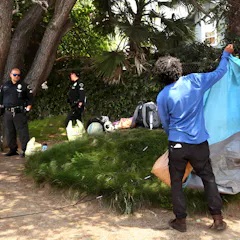
The US Supreme Court’s high-profile Grants Pass ruling allows cities to clear homeless encampments, even if they can’t offer shelter. A scholar explains why a Housing First approach is more effective.
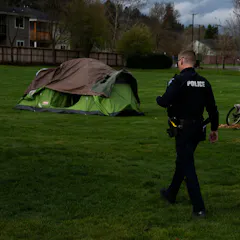
Some courts in Canada are making it possible for people to safely camp in public areas.
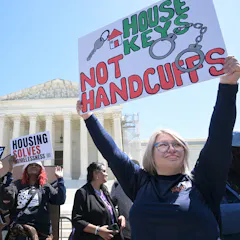
In a major homelessness ruling, the Supreme Court holds that cities and municipalities can punish people for sleeping outside, even when they have nowhere else to go.

Limiting who public space is for and how it can be used is central to settler colonialism both in Canada and other settler colonial places. Here’s how it’s used to silence and criminalize dissent.
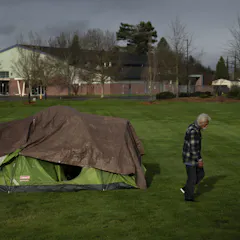
Legal precedents hold that criminalizing someone for their status, such as being homeless, is cruel and unusual punishment. But what if that status leads to actions like sleeping in public spaces?

Encampment sweeps in Edmonton are a brutal attack on both human and treaty rights, as well as a continuation of the violent removal of Indigenous Peoples from their land.

If passed, B.C.’s Bill 45 will trample over the constitutional rights of unhoused people by ignoring shelter barriers, Indigenous rights and the need for daytime shelter
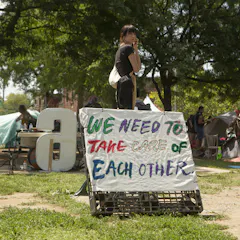
People struggling with homelessness often have limited control over their belongings and face the constant risk of being separated from their possessions.

Cities are clearing homeless encampments, sometimes violently, without providing those who live there any alternatives. Long-term solutions are needed to help people off the streets.
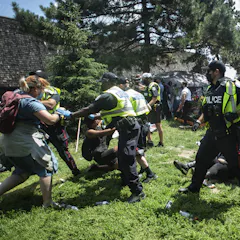
The redefining of ‘the public’ is a helpful step toward listening to those who have experienced homelessness.
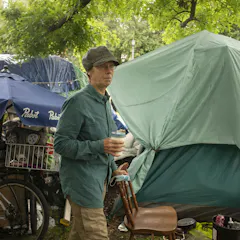
As we push for a real solution — an increase in housing supply and related supports — the encampment evictions must stop. We need to make encampments unnecessary.
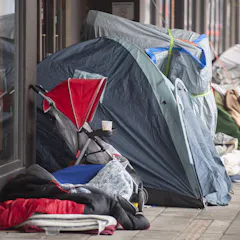
It’s possible to prevent homelessness, but it will take a commitment and dedication to understanding the conditions that produce it.
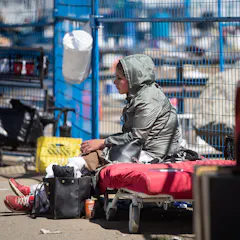
Without sufficient safe shelter space and universal testing, cities are forcing homeless people into encampments, limiting their ability to stay safe and violating international human rights laws.
Top contributors
-

Postdoctoral fellow, Faculty of Education, Simon Fraser University
-
Associate Professor of Sociology and Interdisciplinary Studies, Athabasca University
-
Associate Professor, Law, University of Victoria
-
Professor of the Practice of Law, University of Southern California
-
Professor and Canada Research Chair in Law, Society & Sustainability, University of British Columbia
-
Professor of Human Geography, Simon Fraser University
-
J.D. (Juris Doctor) student at Osgoode Hall Law School, York University, Canada
-
DPhil Candidate in Geography and the Environment | Lecturer in Human Geography, University of Oxford
-
Assistant Professor of Urban and Regional Planning, Michigan State University
-
Ph.D. Candidate in Information Science, University of Washington
-
Professor, Département de droit, Université du Québec en Outaouais (UQO)
-
Professor, Department of Medicine, University of Toronto
-
SJD Candidate, University of Toronto
-
Associate Professor, Peter A. Allard School of Law, University of British Columbia
-
Professor Emeritus, and Director of Housing Research Collaborative, University of British Columbia