
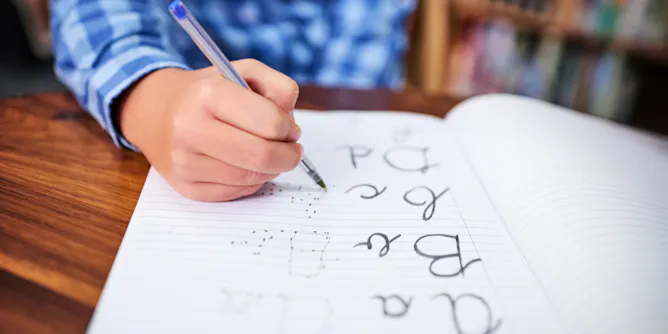
More than 25 states require students to learn to read and write in cursive.
Articles on Handwriting
Displaying 1 - 20 of 25 articles

In today’s classrooms, pens and exercise books are increasingly having to make way for screens and keyboards. Does technology help pupils write as efficiently?

Calligraphy is one of the most significant forms of traditional and modern art in China.
Teachers often have trouble finding enough time in the school day to teach all the expected writing skills, let alone cursive handwriting.

Note-taking on a laptop may be faster but handwriting engages the brain in a more active way than typing.

While the rise of smartphones and typing impacts handwriting, bad penmanship is far from a new phenomenon. People have struggled to read each other’s handwriting for centuries.

It is easy to assume students will be able to write easily and effectively using a keyboard. They are growing up surrounded by technology. But new research shows children write better by hand.

When asked, students say that touch is important in developing reading and writing skills. Research backs them up.
Developmentally progressive instruction allows children to learn handwriting. An open-educational resource by literacy and writing experts supports instruction for kindergarten to Grade 3 children.

The power of a handwritten letter became clear when baseball player Joey Votto penned an apology to Canadian fans. Votto also reopened the debate about whether kids should learn cursive writing.

How does typing affect the way we process what we write, and what are the consequences of giving up handwriting at school age?
Handwriting is a learned skill that must be taught through direct, developmentally progressive, consistent and sustained instruction. Teachers will need professional development and resources.

Similar techniques used to identify criminals have been employed to unmask anonymous authors. But they aren’t foolproof.

Handwriting is not just about forming letters. It also develops fine motor skills, helps with memory and even wellbeing.

The ‘back to basics’ debate over curriculum policy obscures what teachers say they really need: clear guidelines and benchmarks of progress.
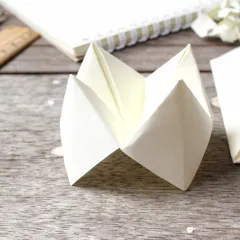
How to make a ‘fortune teller’ or ‘chatterbox’ with children, and why the paper activity targets many developmental domains at once.
A new understanding of the importance of Grade 1 is beginning to change writing education. If your child is missing important basic skills, talk with your child’s teacher to create a plan.

Handwritten letters enhance relationships among people of all ages, and help children become empowered and inspired through the power of the pen.
Developing fluency in handwriting matters for literacy outcomes, and handwriting is an elegant testimony to the unique power of the human voice.

Practice and experience is vital for acquiring a motor skill like handwriting.
Top contributors
-

Professor, Werklund School of Education, University of Calgary
-
Professor in Early Childhood Education and Community, University of Canberra
-
Professor of Cognitive Psychology, University of Leeds
-
Lecturer, School of Education, Murdoch University
-
Associate Professor in Language, Literacy and TESL, University of Canberra
-
Professor of Early Childhood Studies, The University of Melbourne
-
Lecturer in Psychology and Special Educational Needs, UCL
-
Profesora asociada, Facultad de Filología y Comunicación, Universitat de Barcelona
-
Senior Lecturer in Language and Literacy Education, Deakin University
-
Senior Lecturer in Literacy, Edith Cowan University
-
Professor Susan Ledger, Head of School - Dean of Education, University of Newcastle, NSW., University of Newcastle
-
Roger J. Kreuz is a Friend of The Conversation.
Associate Dean and Feinstone Interdisciplinary Research Professor, University of Memphis
-
Professional Learning and Development Facilitator in Literacy Education, Te Kunenga ki Pūrehuroa – Massey University
-
Profesor Titular del Dpto. de Psicología Básica y Metodología, Universidad de Murcia
-
Professor Emerita of Linguistics, American University